 +(91) 9867215033
 info@ujjwalengineers.com
 Maharashtra, Gujarat, India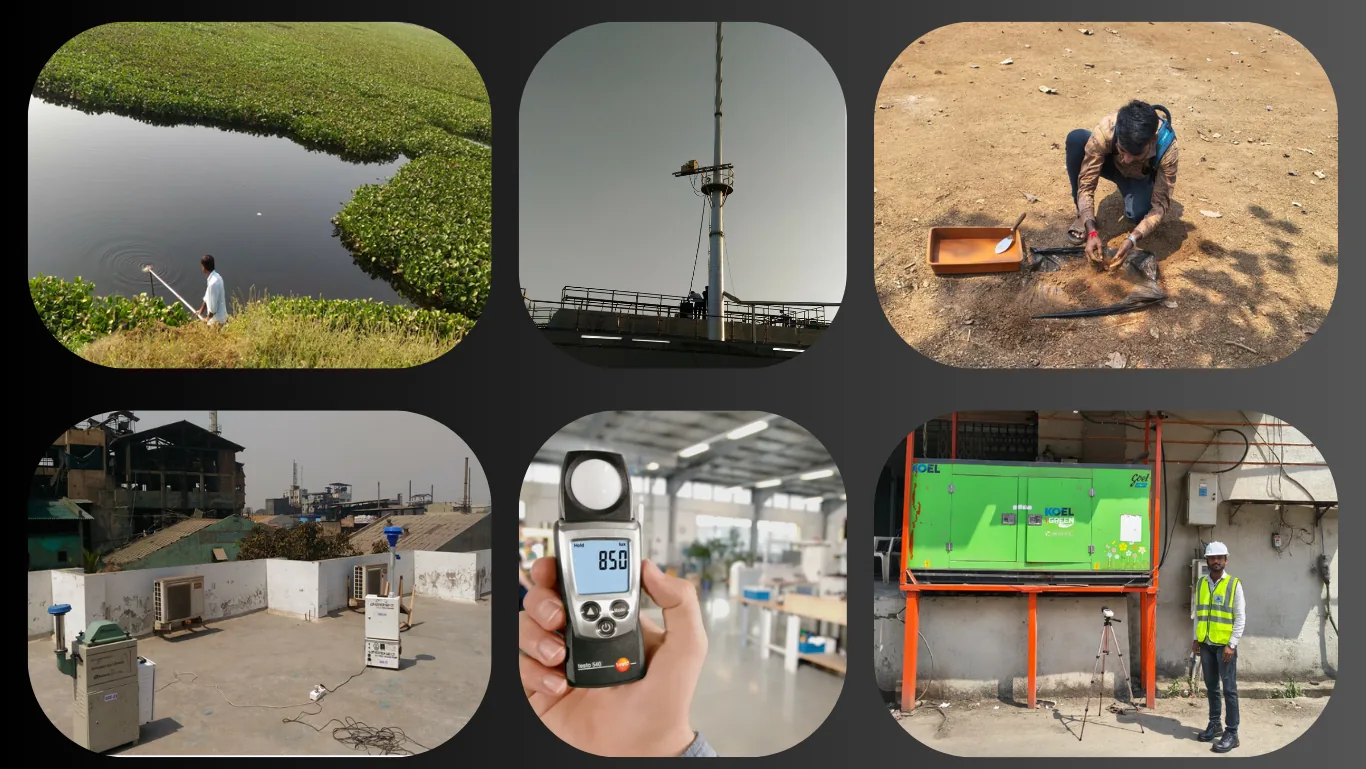
What we monitor
Ambient air quality monitoring is carried out against the National Ambient Air Quality Standards (NAAQS, 2009), which set limits for twelve parameters. In practice most industrial consents call for a subset:
- Particulate matter - PM10 and PM2.5
- Sulphur dioxide (SO2) and oxides of nitrogen (NOx)
- Carbon monoxide, ozone and ammonia
- Volatile organic compounds and benzene, where the process warrants it
- Heavy metals - lead, arsenic, nickel - on the particulate fraction
Why the sampling plan matters more than the lab
A perfectly analysed sample from the wrong location proves nothing. Station siting has to account for the predominant wind direction, distance from the source, nearby receptors and obstructions - and for EIA work, upwind and downwind stations are required so the baseline can be separated from the plant's own contribution.
This is the part that gets challenged at appraisal, and the part that cannot be corrected retrospectively.
Monitoring for environmental clearance
An environmental clearance application needs one full season of baseline data, excluding the monsoon, at multiple stations. That is three months of fieldwork that cannot be shortened, and it is the single most common reason EC timelines slip. If clearance is on your roadmap, baseline monitoring should start before the rest of the application does.
Reports you can file
Results are issued on NABL accredited formats with method references, detection limits and the analyst's signature - the form MPCB, GPCB and appraisal committees accept. Standard turnaround is seven to ten working days from sampling.
Frequently asked questions
How many monitoring stations do we need?
For routine consent compliance, usually one or two within the premises. For environmental clearance, typically eight to twelve stations across the study area, sited on the wind rose and the location of nearby receptors.
How often must ambient air be monitored?
Your consent conditions set the frequency - commonly twice a week for 24-hour samples, or monthly for smaller units. EC baseline work runs continuously through one non-monsoon season.
Is the report valid for MPCB and GPCB?
Yes. Reports are issued through an NABL accredited laboratory in the format both boards require, with the sampling protocol documented alongside the results.
Do you also do stack monitoring?
Yes - see stack emission monitoring. Ambient monitoring measures what reaches the surroundings; stack monitoring measures what leaves the chimney. Consents almost always require both.





 As per MOEF & CC’s (Govt. of India) Office Memorandum F.
No. 22-34/2018-IA.III dated 9th August 2018 Self-Environmental Audit shall be conducted annually. Every
three years third party environmental Audit shall be carried out.
As per MOEF & CC’s (Govt. of India) Office Memorandum F.
No. 22-34/2018-IA.III dated 9th August 2018 Self-Environmental Audit shall be conducted annually. Every
three years third party environmental Audit shall be carried out.