 +(91) 9867215033
 info@ujjwalengineers.com
 Maharashtra, Gujarat, India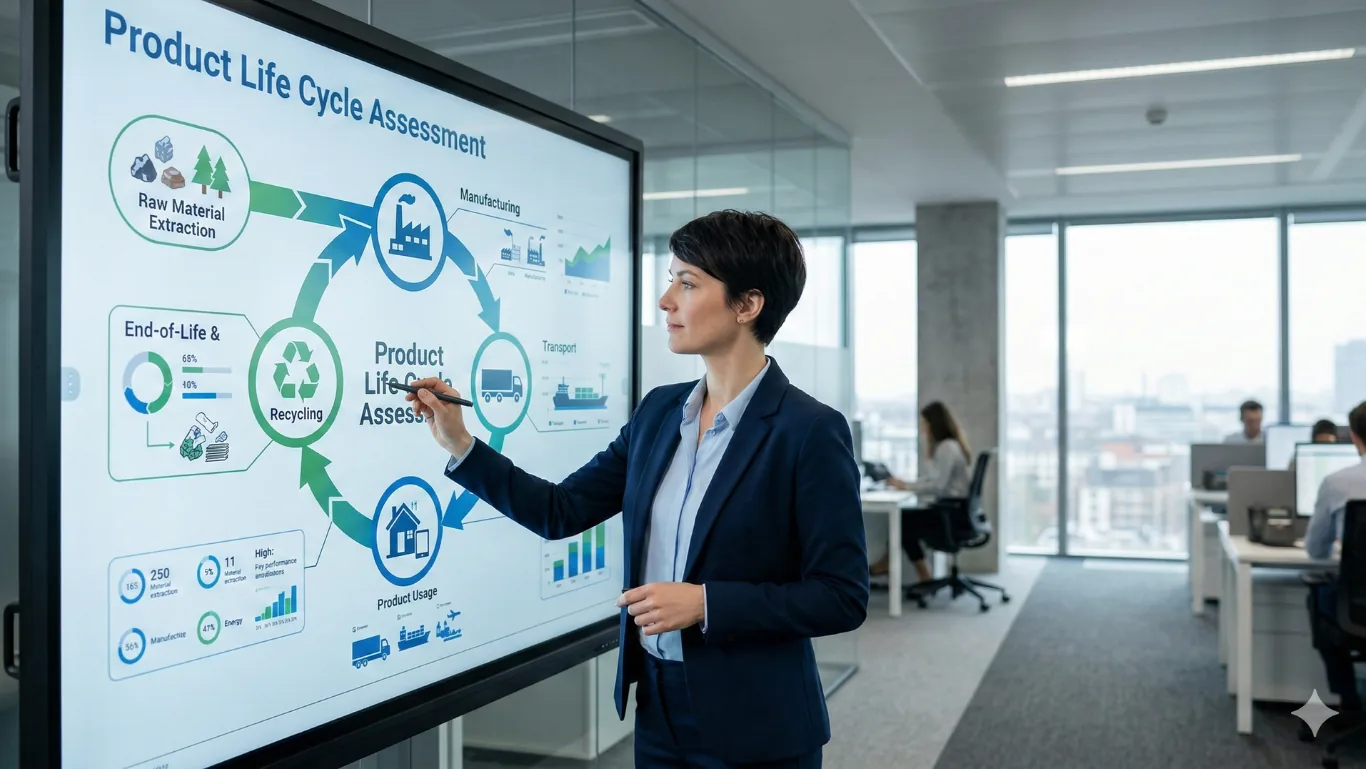
Sustainability Consulting for Indian Industry
Ujjwal Engineers & Environmental Services (UEES) is an ISO 9001:2015 certified sustainability consulting company working with petrochemical, chemical, pharmaceutical and manufacturing clients across Maharashtra, Gujarat and pan-India. We help organisations measure their environmental impact, reduce it, and report it in a form that customers, investors and regulators accept.
Most companies come to us because a customer has asked for emissions data, an EcoVadis scorecard or a product footprint - and the request has a deadline attached. Our work starts with measurement, because targets set before measurement are guesswork.
What our sustainability consultancy covers
Carbon and climate
- GHG emission reporting across Scope 1, 2 and 3, following the GHG Protocol Corporate Standard
- Product carbon footprint quantification for individual products and SKUs
- Life Cycle Assessment to ISO 14040 and ISO 14044, covering impacts beyond carbon alone
ESG ratings and disclosure
- EcoVadis ESG consulting and scorecard improvement across environment, labour, ethics and sustainable procurement
- Evidence preparation and gap analysis for customer sustainability questionnaires
Resource efficiency and built environment
- Green building consultancy and IGBC certification
- Zero liquid discharge engineering - water recovery and reuse through RO, MEE, MVR and ATFD systems
- EPR compliance for plastic packaging and e-waste
Why organisations choose a sustainability consultancy firm
Three pressures now drive most sustainability work in India, and they arrive in a predictable order:
- Customer requirements. Large buyers ask suppliers for emissions data because their own Scope 3 inventory depends on it. If you supply a multinational, the request is coming.
- Regulatory disclosure. SEBI's Business Responsibility and Sustainability Reporting framework applies to India's largest listed companies, with assurance on a subset of indicators phased in over time.
- Export exposure. Mechanisms such as the EU Carbon Border Adjustment Mechanism place reporting obligations on importers of carbon-intensive goods, and those obligations flow back to exporting manufacturers.
How we work
- Measure first. Boundaries, base year and a defensible inventory, built from records you already hold.
- Find what matters. A small number of categories usually dominate the footprint. Effort goes there rather than everywhere.
- Document the method. Assurance and customer audits test the method, not just the number.
- Reuse the data. One inventory supports GHG reporting, product footprints, LCA and ESG ratings. Collected once, used several times.
Frequently Asked Questions
What does a sustainability consulting company actually do?
A sustainability consultancy helps an organisation measure its environmental impact, reduce it, and report it credibly. In practice that means quantifying emissions and resource use, identifying where the largest impacts sit, supporting certification and rating assessments, and preparing the disclosures that customers, investors and regulators ask for.
How is sustainability consulting different from environmental compliance?
Compliance work keeps an organisation on the right side of statutory obligations - consents, clearances, audits and returns. Sustainability consulting goes beyond the legal minimum and addresses performance: carbon footprint, resource efficiency, ESG ratings and voluntary disclosure. Most organisations need both, and the data collected for one usually supports the other.
Which standards do sustainability assessments follow?
Life cycle assessment follows ISO 14040 and ISO 14044. Product carbon footprinting commonly follows ISO 14067 or the GHG Protocol Product Standard. Corporate greenhouse gas accounting follows the GHG Protocol Corporate Standard. Green building certification in India is most often IGBC, with LEED and GRIHA as alternatives.
Do sustainability consultants work with small and mid-sized companies?
Yes. A large share of demand now comes from mid-sized manufacturers and exporters whose customers have begun requesting emissions data, EcoVadis scorecards or product footprints as a condition of supply. Scope can be matched to what a specific customer or framework actually requires rather than starting with a full programme.
How long does it take to see results from sustainability work?
A corporate greenhouse gas inventory or an EcoVadis submission can usually be completed within a defined project window once data collection is underway. Measurable reductions take longer, because they follow operational change. The sequence that works is measure first, then prioritise, then act - improvement targets set before measurement tend to be arbitrary.





 As per MOEF & CC’s (Govt. of India) Office Memorandum F.
No. 22-34/2018-IA.III dated 9th August 2018 Self-Environmental Audit shall be conducted annually. Every
three years third party environmental Audit shall be carried out.
As per MOEF & CC’s (Govt. of India) Office Memorandum F.
No. 22-34/2018-IA.III dated 9th August 2018 Self-Environmental Audit shall be conducted annually. Every
three years third party environmental Audit shall be carried out.