
 +(91) 9867215033
 info@ujjwalengineers.com
 Maharashtra, Gujarat, India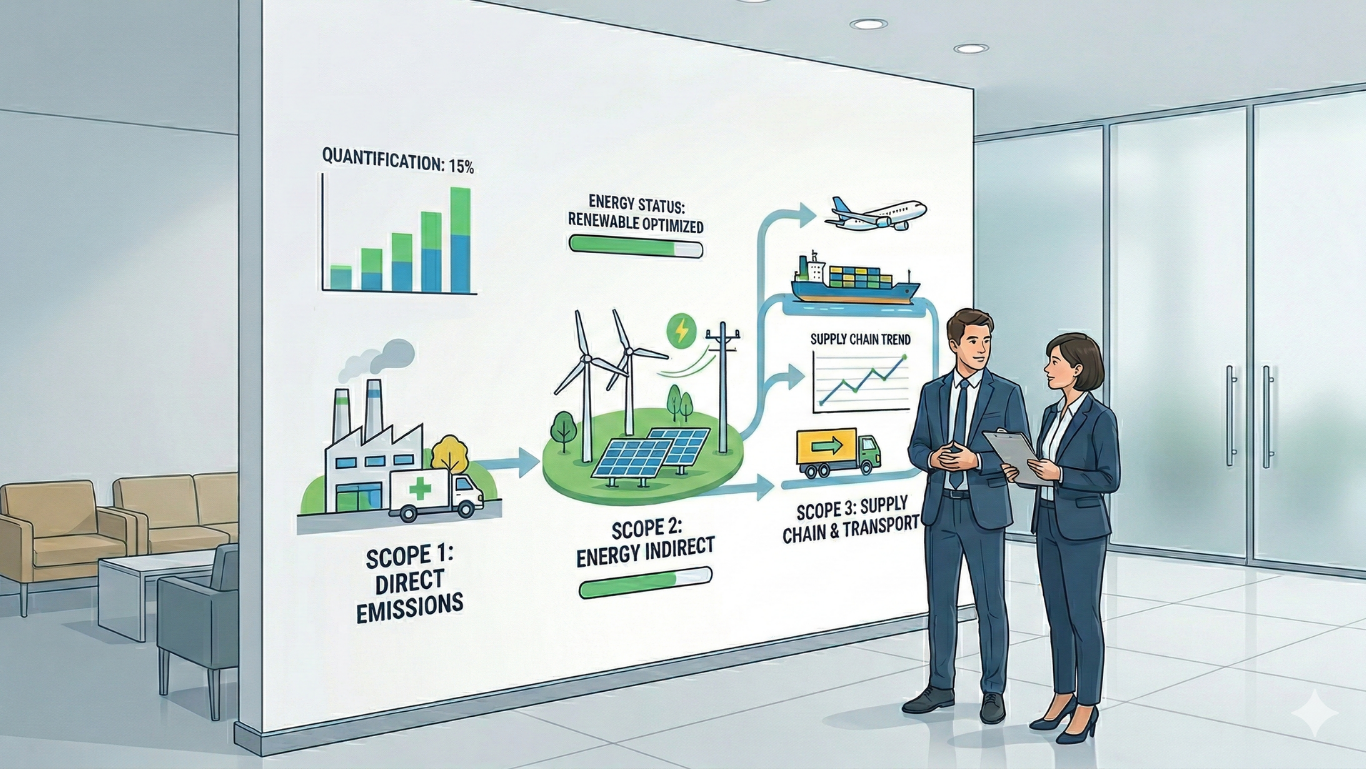
If a customer, an investor or a disclosure framework has recently asked your organisation about its Scope 1, 2 and 3 emissions, the terms can look more technical than they actually are. They are simply three buckets for sorting greenhouse gas emissions by how much control you have over them.
This guide explains each scope in plain language, why the distinction matters, and what is realistically involved in producing numbers you can stand behind.
Where the three scopes come from
The classification comes from the GHG Protocol Corporate Accounting and Reporting Standard, which is the most widely used framework for corporate greenhouse gas accounting worldwide. Most disclosure frameworks, customer questionnaires and rating platforms are built on top of it.
The logic is straightforward: emissions are grouped by ownership and control, so that when several companies in the same value chain report, the same tonne of emissions is not double-counted at the same scope.
Scope 1: emissions you produce directly
Scope 1 covers greenhouse gases released from sources your organisation owns or controls. If it burns on your site or in your vehicle, it is almost certainly Scope 1.
- Fuel burnt in boilers, furnaces, kilns and process heaters
- Diesel consumed by captive generators
- Fuel used by company-owned vehicles
- Process emissions released by chemical reactions themselves
- Fugitive emissions, such as refrigerant leakage from chillers and air conditioning
Scope 1 is usually the easiest to quantify, because the underlying data — fuel purchase records, meter readings, refrigerant top-up logs — already exists somewhere in your organisation.
Scope 2: emissions from the energy you buy
Scope 2 covers emissions generated elsewhere to produce the energy you purchase and consume — overwhelmingly, for most Indian organisations, this means grid electricity. It also covers purchased steam, heat and cooling.
You do not operate the power plant, but you caused the generation by drawing the power, so the emissions sit in your inventory as an indirect but closely attributable category.
Scope 2 is normally calculated by applying a grid emission factor to your metered consumption. Because it is driven by a single, well-recorded number, it is generally the most straightforward scope to calculate — and often the easiest to reduce, through energy efficiency or renewable procurement.
Scope 3: everything else in your value chain
Scope 3 covers all other indirect emissions across your value chain, both upstream and downstream. The GHG Protocol divides it into fifteen categories, including purchased goods and services, capital goods, upstream transport and distribution, waste generated in operations, business travel, employee commuting, downstream transport, use of sold products, and end-of-life treatment of sold products.
The uncomfortable part: for most organisations, Scope 3 is by far the largest share of total emissions — and the hardest to measure, because the data belongs to your suppliers and your customers rather than to you.
The three scopes side by side
| Aspect | Scope 1 | Scope 2 | Scope 3 |
|---|---|---|---|
| What it covers | Direct emissions from owned or controlled sources | Indirect emissions from purchased energy | All other indirect emissions in the value chain |
| Typical examples | Boiler fuel, DG sets, company vehicles, refrigerant leaks | Purchased grid electricity, steam, heat, cooling | Purchased goods, logistics, business travel, product use and disposal |
| Data source | Your own fuel and refrigerant records | Your electricity bills and meter readings | Suppliers, logistics partners, customers, industry averages |
| Difficulty | Low to moderate | Low | High |
| Share of total footprint | Usually smaller | Usually moderate | Usually the largest |
| Your degree of control | Direct | Through procurement choices | Through influence rather than control |
Why Indian businesses are being asked for this
Three separate pressures have made GHG accounting a practical business requirement rather than a voluntary exercise:
- Regulatory disclosure. SEBI's Business Responsibility and Sustainability Reporting (BRSR) framework requires India's largest listed companies to disclose sustainability information, including emissions, with a subset of BRSR Core indicators subject to assurance on a phased basis.
- Customer requirements. Large buyers increasingly ask suppliers for emissions data, because their own Scope 3 inventory depends on it. If you supply a multinational, the request is likely coming whether or not you are directly regulated.
- Export exposure. Mechanisms such as the EU's Carbon Border Adjustment Mechanism (CBAM) place reporting obligations on importers of certain carbon-intensive goods, and those obligations flow back to exporting manufacturers in sectors including iron and steel, aluminium, cement and fertilisers.
Because these frameworks and their applicability thresholds continue to evolve, your specific obligations should be confirmed against the current requirements for your sector and market rather than assumed.
How to start without being overwhelmed
The most common failure mode is trying to do all fifteen Scope 3 categories at once and stalling. A workable sequence looks like this:
- Set boundaries first. Decide which entities and sites are included and which consolidation approach you are using, and write it down. Changing this later invalidates comparisons.
- Pick a base year. Every reduction claim is measured against it, so choose a year with reasonably reliable data.
- Complete Scope 1 and 2 properly. They are achievable with data you already hold, and they establish the discipline for the harder work.
- Screen Scope 3 before measuring it. Estimate all categories roughly, identify the few that dominate, then invest effort there. For most organisations a small number of categories account for the bulk of Scope 3.
- Document your method. Record every emission factor, assumption and data source. Assurance and customer audits test the method, not just the number.
Once the corporate inventory is in place, it becomes the foundation for product-level carbon footprinting, for Life Cycle Assessment, and for rating platforms such as EcoVadis. Organisations that build the inventory carefully the first time find every subsequent request far less painful.
Frequently Asked Questions
What is the difference between Scope 1, 2 and 3 emissions?
Scope 1 covers direct emissions from sources an organisation owns or controls, such as boiler fuel, generators and company vehicles. Scope 2 covers indirect emissions from purchased energy, principally grid electricity. Scope 3 covers all other indirect emissions across the value chain, including purchased goods and services, logistics, business travel and the use and disposal of sold products.
Is Scope 3 reporting mandatory in India?
Requirements depend on the framework that applies to your organisation. SEBI's BRSR framework applies to India's largest listed companies, with a subset of BRSR Core indicators subject to phased assurance. Many unlisted companies encounter emissions requests indirectly, through customers who need the data for their own Scope 3 inventory. Because thresholds and requirements continue to evolve, your specific obligation should be confirmed against the current framework.
Which scope is usually the largest?
For most organisations Scope 3 is by far the largest share of the total footprint, because it captures the entire upstream and downstream value chain. It is also the hardest to quantify, since the underlying data sits with suppliers and customers rather than within your own operations.
Do I need to measure all fifteen Scope 3 categories?
Not immediately, and rarely all at the same level of rigour. Standard practice is to screen all categories to identify which ones are material, then focus measurement effort on those. For most organisations a small number of categories account for the majority of Scope 3 emissions, and reporting should be transparent about which categories are included and which are not.
What data do I need to start a GHG inventory?
For Scope 1, fuel purchase and consumption records, generator running logs and refrigerant top-up records. For Scope 2, electricity bills and meter readings, plus any purchased steam, heat or cooling. For Scope 3, procurement spend or quantity data, logistics records, travel records and waste records. Most organisations already hold the Scope 1 and 2 data; the initial work is usually collecting it consistently rather than generating it.
Need expert help with this?
We help organisations build their GHG inventory across Scope 1, 2 and 3, and prepare it for disclosure, assurance and customer requirements.
Start Your GHG Inventory