 +(91) 9867215033
 info@ujjwalengineers.com
 Maharashtra, Gujarat, India
Search for top environmental consulting firms and you will get lists. Lists are not much use, because the firm that is right for a pharmaceutical plant seeking Environmental Clearance is rarely the right firm for a ceramic unit renewing its air consent.
What follows is the set of questions that actually predict whether a project will go smoothly - written by people who have inherited more than a few projects that did not.
1. Is the accreditation right for your sector?
This is the one that disqualifies fastest. EIA studies must be prepared by organisations accredited by NABET under the Quality Council of India, and that accreditation is sector-specific.
Ask directly: "Are you NABET accredited for my sector, and can I see the current certificate?" A firm accredited for a different sector cannot prepare your EIA - and discovering that after signing costs months, not money.
2. Is there an in-house laboratory, or is testing subcontracted?
Environmental work runs on monitoring data. Where a consultancy subcontracts testing, two things follow: schedules depend on somebody else's queue, and data quality varies with whoever picked up the work.
This matters more than it appears because monitoring gaps cannot be filled retrospectively. If a required quarter was never sampled, no amount of effort later creates that data - it becomes a permanent hole in your compliance record.
Ask whether the laboratory is NABL accredited, and for which parameters.
3. Do they know your regulator specifically?
The Water Act, 1974 and the Air Act, 1981 are central statutes, but they are administered by state boards - and the boards differ in procedure, portal, fee structure and expectations.
A firm fluent with MPCB in Maharashtra is not automatically fluent with GPCB in Gujarat. If you operate in both states, ask specifically about both.
4. Can they engineer what they promise?
Clearances and consents are frequently granted on the strength of what you commit to build - an effluent treatment upgrade, a zero liquid discharge train, an emission control system.
A consultancy that only writes reports can commit you to something that turns out to be impractical or unaffordable. One that also designs and installs the systems has to live with what it promised.
5. Who actually does the work?
A recurring and expensive pattern: the senior person who wins the work is not the person who does it. Ask who will run your HAZOP, who will attend the public hearing, who will respond to the appraisal committee's queries - by name.
6. Do they give you realistic timelines, or comfortable ones?
Some parts of an environmental project simply cannot be compressed. Baseline monitoring for an EIA normally requires one full season excluding the monsoon. That is a fixed block of calendar time.
A useful test: a firm that promises Environmental Clearance unrealistically quickly either does not understand the process or is telling you what you want to hear. Both are reasons to walk away.
7. What happens after the approval?
Clearance conditions are binding for the life of the project and require periodic compliance reporting. Consents need renewal. Returns are due annually.
A firm that disappears at approval leaves you with obligations and no support. Ask what ongoing compliance support looks like, and what it costs.
A short checklist
| Ask | Why it matters |
|---|---|
| NABET accreditation for my sector? | Without it they cannot prepare your EIA |
| NABL laboratory in-house? | Controls schedule and data quality |
| Experience with my state board? | MPCB and GPCB work differently |
| Engineering capability? | Commitments have to be buildable |
| Who does the work, by name? | Avoids the bait-and-switch |
| Realistic timeline, with the fixed parts identified? | Tests whether they know the process |
| Post-approval support? | Obligations continue for years |
On cost
The cheapest quote is frequently the most expensive outcome. Rework after a rejected submission, a missed monitoring season, or a clearance condition that cannot be met in practice all cost far more than the difference between two proposals.
Compare scope before comparing price. A quote that excludes baseline monitoring is not cheaper than one that includes it - it is a different quote.
Frequently Asked Questions
What is NABET accreditation and why does it matter?
NABET, the National Accreditation Board for Education and Training under the Quality Council of India, accredits organisations to prepare Environmental Impact Assessment reports. The accreditation is granted for specific sectors, so a consultancy accredited for one sector cannot prepare an EIA for a project in another. Always ask to see the current certificate covering your sector.
Should an environmental consultant have its own laboratory?
It is a significant advantage. Environmental work depends on monitoring data, and where testing is subcontracted both scheduling and data quality depend on a third party. Since monitoring gaps cannot be filled retrospectively, control over the sampling calendar has real value. Ask whether the laboratory is NABL accredited and for which parameters.
Does it matter which state my consultant is based in?
The statutes are central but they are administered by state pollution control boards, and procedures, portals, fee structures and timelines differ between states. Familiarity with the specific board that regulates your unit matters. If you operate in more than one state, ask about each board separately.
How do I judge whether a proposed timeline is realistic?
Look for whether the firm identifies the parts of the process that cannot be compressed. Baseline monitoring for an EIA normally requires one full season excluding the monsoon, and public consultation has its own notice periods. A proposal that does not acknowledge these fixed blocks is not a realistic schedule.
Is the cheapest environmental consultancy quote usually the right choice?
Not usually, and often the scope differs rather than the price. Check whether baseline monitoring, public consultation support and query responses are included before comparing figures. Rework after a rejected submission or a missed monitoring season typically costs far more than the difference between proposals.
Need expert help with this?
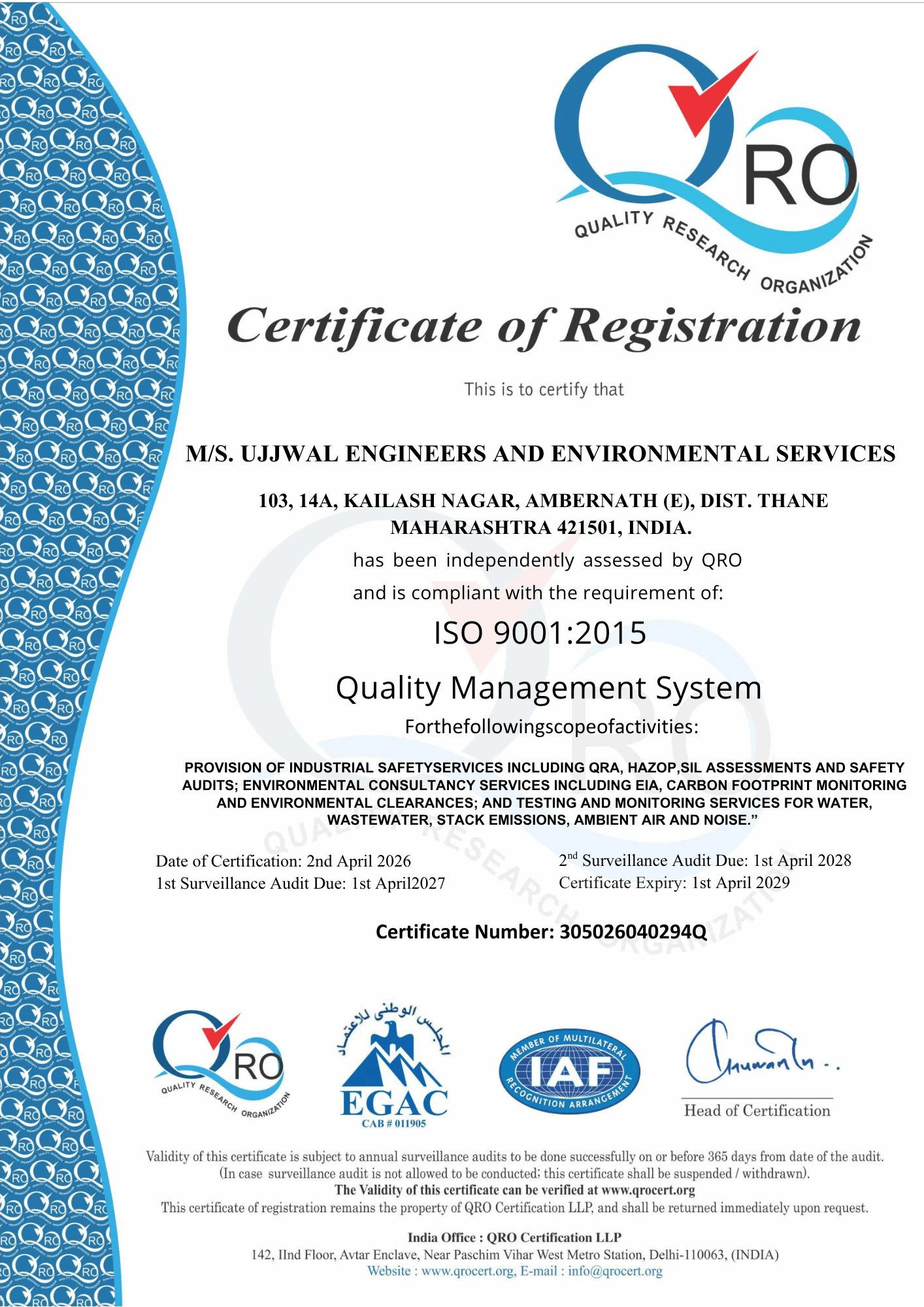
We are an ISO 9001:2015 certified environmental consultancy with an in-house NABL-accredited laboratory, working with MPCB and GPCB regulated industry.
Talk to Our Team