 +(91) 9867215033
 info@ujjwalengineers.com
 Maharashtra, Gujarat, India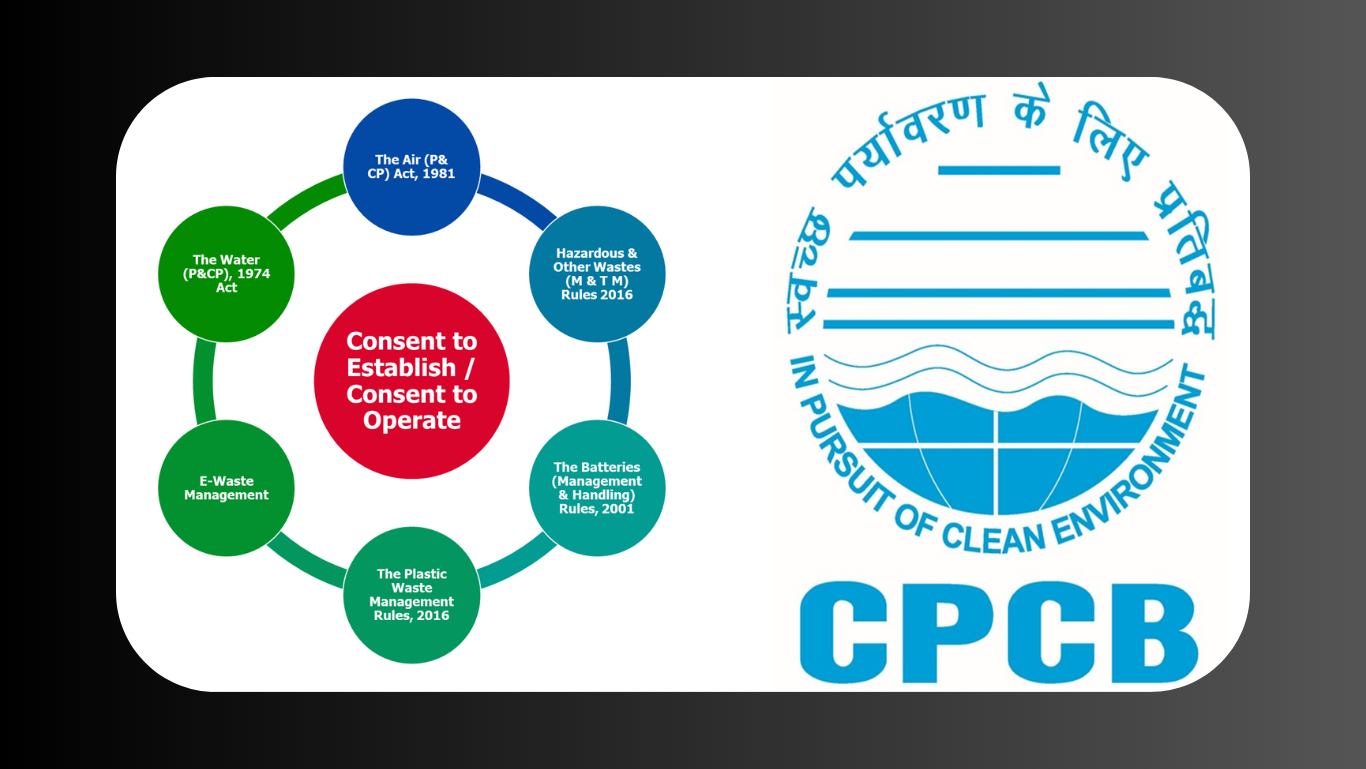
Almost every industrial or commercial establishment in India needs consent from its State Pollution Control Board before it can be built and before it can operate. These two permissions — Consent to Establish (CTE) and Consent to Operate (CTO) — are sometimes treated as one formality. They are not.
Applying for the wrong one, or applying at the wrong point in the project, is one of the more common and more expensive mistakes we see.
The legal basis
Both consents are issued by the State Pollution Control Board under two statutes:
- The Water (Prevention and Control of Pollution) Act, 1974
- The Air (Prevention and Control of Pollution) Act, 1981
In Maharashtra the authority is the Maharashtra Pollution Control Board (MPCB); in Gujarat it is the Gujarat Pollution Control Board (GPCB). The underlying legislation is central, but application procedures, portals, fee structures and timelines are administered at state level and differ between states.
Consent to Establish (CTE)
CTE is the permission to set up — to construct the unit and install plant and machinery. It is applied for before construction begins, on the basis of the proposed design.
At this stage the Board is assessing intent and design adequacy: what you plan to manufacture, at what capacity, what effluent and emissions you expect to generate, and what pollution control equipment you propose to install to manage them.
Common mistake: starting civil work before CTE is granted. Construction undertaken without consent can attract enforcement action, and regularising it afterwards is considerably harder than obtaining the consent in the first place.
Consent to Operate (CTO)
CTO is the permission to run the unit. It is applied for once construction is complete and the pollution control systems are actually installed — but before commercial production starts.
Here the Board is verifying reality against the promise: whether the effluent treatment plant, air pollution control equipment and waste handling arrangements described in the CTE have in fact been provided, and whether the unit can meet the prescribed discharge and emission standards. A site inspection is typically part of the process.
Unlike CTE, CTO is not a one-time approval. It is granted for a defined period and must be renewed before expiry, for as long as the unit operates.
CTE vs CTO: the difference side by side
| Aspect | Consent to Establish (CTE) | Consent to Operate (CTO) |
|---|---|---|
| Purpose | Permission to construct and install | Permission to commence and continue operations |
| When to apply | Before any construction starts | After construction and installation, before production starts |
| Basis of assessment | Proposed design and projected pollution load | Actual installed systems and demonstrated performance |
| Site inspection | May be carried out | Normally carried out before grant |
| Validity | Linked to the project implementation period | Granted for a defined period and renewable |
| Renewal required | No, but extension may be needed if the project is delayed | Yes, throughout the operating life of the unit |
| Consequence of skipping | Construction may be treated as unauthorised | Operation without valid consent can lead to closure directions |
Your category decides almost everything
The Central Pollution Control Board classifies industries into Red, Orange, Green and White categories based on their pollution potential. This categorisation drives the consent validity period, the fee, the level of scrutiny, and the frequency of monitoring your unit will face.
White category activities are the least polluting and are treated most lightly — in many states they do not require consent in the usual sense, only an intimation to the Board. Red category units face the shortest consent validity periods and the most detailed scrutiny.
Confirming your correct category before applying is worth the effort. An application filed under the wrong category is a predictable source of rejection and rework.
Where CTE and CTO fit alongside other approvals
Consents are frequently confused with Environmental Clearance. They are separate approvals under separate statutes, granted by different authorities:
- Environmental Clearance is granted under the Environment (Protection) Act, 1986, by MoEFCC or SEIAA, and is required only for the project categories listed in the EIA Notification, 2006.
- CTE and CTO are granted by the State Pollution Control Board under the Water Act and the Air Act, and apply far more broadly.
Where a project requires Environmental Clearance, that clearance is normally expected to be in place before the consent process concludes. Depending on your activity you may additionally need authorisation for hazardous waste handling, biomedical waste, or Extended Producer Responsibility registration for plastic or e-waste.
Five mistakes that cause the most delay
- Beginning construction before CTE is granted. Difficult and expensive to regularise afterwards.
- Applying under the wrong category. Determine Red, Orange, Green or White status before filing, not after a query is raised.
- Capacity mismatches across documents. Figures that differ between the consent application, the project report and the clearance documents will trigger queries.
- Letting CTO lapse. Renewal should be initiated well before expiry. Operating on an expired consent is a serious enforcement risk.
- Not amending after changes. Capacity expansion, a new product, or a change in raw materials generally requires the consent to be amended. Continuing under the old consent creates a compliance gap that surfaces at the next inspection.
Consents are only the entry point. Once operating, units carry continuing obligations — periodic returns, monitoring, and record keeping — covered under statutory environmental compliance and reporting, supported by environmental monitoring and analysis.
Frequently Asked Questions
Can I apply for CTE and CTO at the same time?
They are sequential by design. CTE is granted on the basis of a proposed design before construction, while CTO is granted after the pollution control systems are actually installed and can be verified. Some states have introduced combined or streamlined procedures for certain categories, so the position in your state should be confirmed with the concerned Board.
What happens if my Consent to Operate expires?
Operating without a valid consent is a contravention of the Water Act, 1974 and the Air Act, 1981 and can attract enforcement action, including directions to stop operations. Renewal should be initiated well before the expiry date rather than after it.
Do I need CTE and CTO if I already have Environmental Clearance?
Yes. Environmental Clearance is granted under the Environment (Protection) Act, 1986 by MoEFCC or SEIAA. CTE and CTO are granted separately by the State Pollution Control Board under the Water Act and the Air Act. They are distinct approvals serving different purposes and both are required where applicable.
Is consent required for a White category unit?
White category activities are the least polluting and are treated differently. In many states they do not require consent in the conventional sense and only an intimation to the Board is needed. Because the treatment of White category units varies between states, the position should be confirmed with the relevant State Pollution Control Board.
What happens if I expand capacity after getting CTO?
A capacity expansion, a new product, or a change in raw materials generally requires the existing consent to be amended or a fresh consent to be obtained. Continuing to operate under a consent that no longer reflects actual operations creates a compliance gap that is typically identified during inspection.
Need expert help with this?
We manage CTE and CTO applications, renewals and amendments with MPCB, GPCB and other State Pollution Control Boards.
Get Help With Your Consent