
 +(91) 9867215033
 info@ujjwalengineers.com
 Maharashtra, Gujarat, India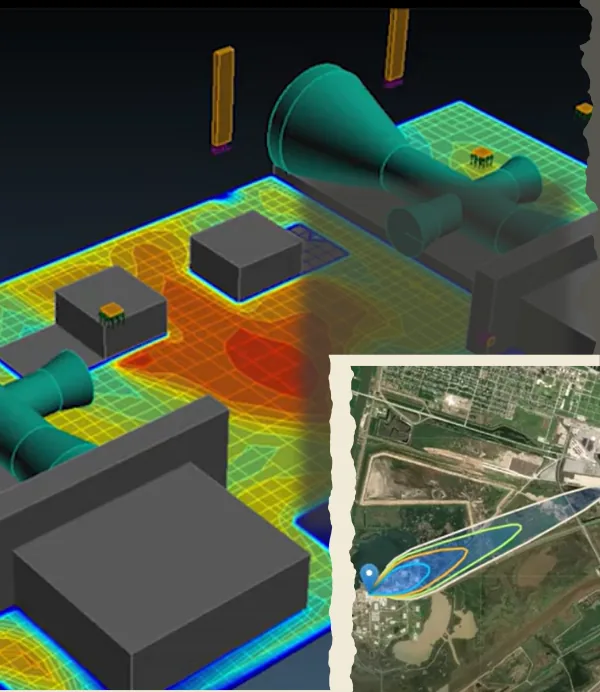
Hazard identification produces a list of things that could go wrong. Consequence modelling answers the question that follows immediately: if it does, how far does it reach, and how bad is it at that distance?
It is the step that turns a hazard register into a map with numbers on it.
The scenarios
| Scenario | What it models | Output |
|---|---|---|
| Pool fire | A liquid pool ignites | Thermal radiation against distance |
| Jet fire | A pressurised release ignites at the point of leak | Flame length, radiation contours |
| Flash fire | A drifting cloud finds an ignition source | Flammable cloud footprint |
| Vapour cloud explosion | Congested cloud ignites and generates overpressure | Overpressure contours |
| BLEVE | Pressurised vessel fails while engulfed in fire | Fireball radiation, fragment range |
| Toxic dispersion | A toxic release disperses downwind | Concentration against distance |
What the inputs actually control
The single most common weakness in a consequence report is that it was run on default inputs. The result then looks authoritative and means very little.
Weather does most of the work
For a dispersion case, atmospheric stability and wind speed can move the impact distance by a large factor. A stable, low-wind night case and an unstable, windy daytime case are different problems - the first carries a cloud a long way at concentration, the second dilutes it quickly. A study that models only one is answering half the question.
Release definition
Hole size, inventory, pressure, temperature, phase and duration all shape the outcome. A "full bore rupture" and a "10 mm leak" of the same chemical produce answers that are not comparable, and the choice of which to model should follow from the scenarios your HAZOP identified, not from convention.
Terrain and surface
Surface roughness changes dispersion behaviour. Open water, flat farmland and congested plant behave differently, and dense gases follow terrain downhill in a way flat-terrain assumptions do not capture.
Where these models stop being reliable
Integral models assume relatively open, uniform terrain. Inside congested plant, around large structures, or within buildings and enclosures, they can be significantly wrong - and not always conservatively. That is the point at which CFD modelling becomes worth its extra cost and time.
What the results get used for
- Layout and separation. Where can the next unit, the control room or the occupied building go?
- Input to QRA. Consequence is one half of risk; frequency is the other.
- Emergency planning. Evacuation distances and assembly point siting should follow modelled distances, not round numbers.
- Detector and alarm siting. Where a release actually travels determines where detection needs to be.
- MAH documentation and on-site emergency plans.
- FERA and escalation assessment.
Reading a consequence report critically
Three questions expose most weak studies:
- Which weather cases were modelled, and where did the data come from?
- Why were these release sizes chosen, and what scenario list are they from?
- What are the stated limitations? A report without a limitations section has either not thought about them or has chosen not to mention them.
Frequently Asked Questions
What is the difference between consequence analysis and QRA?
Consequence analysis models the physical outcome of a release - how far radiation, overpressure or toxic concentration reaches. QRA combines those consequences with how frequently each scenario is expected to occur, producing risk measures such as individual risk contours and societal risk. Consequence analysis is an input to QRA.
Why does weather data matter so much in dispersion modelling?
Atmospheric stability and wind speed strongly affect how far a cloud travels before diluting below a threshold of concern. Stable, low-wind conditions can carry a release much further at concentration than unstable, windy conditions. Studies should model a range of representative cases using site-specific meteorological data rather than generic defaults.
When is CFD needed instead of standard dispersion modelling?
When the geometry drives the answer - congested plant, enclosures, buildings, or ventilation questions. Integral models assume relatively open, uniform terrain and can be materially wrong in congested areas. For open tank farms and simple layouts, standard models are usually adequate.
What release size should be modelled?
It should follow from the scenarios identified in hazard studies rather than from convention. Commonly a range is modelled, from small leaks through to larger failures, because they produce very different impact distances and inform different decisions.
Can consequence modelling results be used for emergency planning?
Yes, and that is one of their most practical uses. Modelled impact distances give a defensible basis for evacuation distances, assembly point siting and shelter decisions, rather than the round numbers that often get used by default.
Need expert help with this?
We carry out consequence and dispersion analysis using site-specific meteorological data, feeding QRA, layout decisions and emergency planning.
Discuss a Consequence Study