
 +(91) 9867215033
 info@ujjwalengineers.com
 Maharashtra, Gujarat, India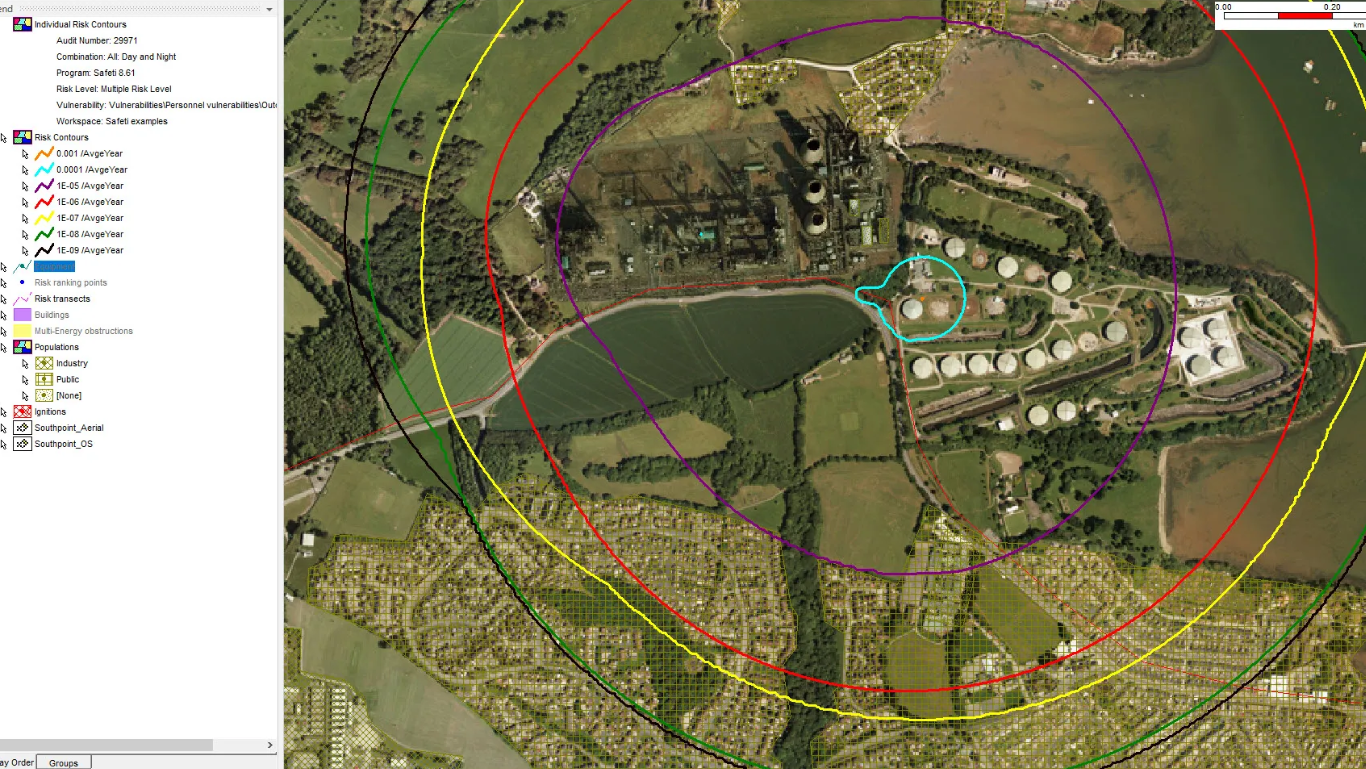
HAZOP and QRA are two of the most widely used studies in process safety, and two of the most frequently confused. They are often written into the same tender document, sometimes treated as interchangeable, and occasionally one is commissioned when the other was actually needed.
They answer genuinely different questions. Understanding which question you are trying to answer is the fastest way to decide what you need.
The short version: HAZOP asks "what can go wrong here, and are our safeguards adequate?" QRA asks "how likely is it, and how bad would the consequences be in numbers?"
What is a HAZOP study?
HAZOP stands for Hazard and Operability study. It is a structured, qualitative, team-based examination of a process, carried out systematically against the P&IDs.
The plant is divided into nodes — manageable sections such as a line between two vessels. For each node, the team applies guide words to process parameters to generate deviations from the design intent:
| Guide word | Parameter | Example deviation |
|---|---|---|
| No | Flow | No flow through the feed line |
| More | Pressure | Pressure higher than design |
| Less | Temperature | Temperature below the required minimum |
| Reverse | Flow | Backflow into the upstream vessel |
| As well as | Composition | Contaminant present in the stream |
For every credible deviation, the team records the possible causes, the consequences, the safeguards already in place, and — where the safeguards are not adequate — a recommendation. The methodology is described in IEC 61882.
A HAZOP is only as good as the team around the table. It needs process, operations, instrumentation and maintenance representation, an experienced independent facilitator, and a dedicated scribe. A HAZOP run by one person reading a checklist is not a HAZOP.
What is a QRA?
QRA stands for Quantitative Risk Assessment. Where HAZOP is descriptive, QRA is numerical. It estimates risk by combining how likely an event is with how severe its consequences would be.
A QRA typically works through four steps:
- Hazard identification — which release scenarios are credible (often drawing on the HAZOP output)
- Consequence modelling — modelling pool fires, jet fires, flash fires, vapour cloud explosions and toxic dispersion, using site-specific weather and terrain data
- Frequency analysis — estimating how often each scenario occurs, using historical failure rate data and techniques such as fault tree and event tree analysis
- Risk integration — combining the two into risk measures that can be compared against criteria
The outputs are quantitative: individual risk contours plotted over the site layout, and societal risk presented as F-N curves. These can be compared against tolerability criteria and used to justify decisions about layout, separation distances, and emergency planning.
HAZOP vs QRA at a glance
| Aspect | HAZOP | QRA |
|---|---|---|
| Nature | Qualitative | Quantitative |
| Core question | What can deviate, and are safeguards adequate? | How likely, and how severe, expressed in numbers? |
| Main input | P&IDs, operating procedures, design intent | Release scenarios, failure rate data, plot plan, meteorological data |
| Method | Team workshop using guide words, node by node | Consequence modelling and frequency analysis, usually software-assisted |
| Typical output | Deviation worksheets and prioritised recommendations | Risk contours, F-N curves, risk ranking |
| Best timing | Once P&IDs are firm; repeated after major modifications | Layout and siting decisions; MAH installations; land use planning |
| Answers "is the design safe?" | Yes, in engineering judgement terms | Yes, against numerical risk criteria |
They are not alternatives
The most common mistake is treating HAZOP and QRA as competing options. In a mature process safety programme they are sequential and complementary.
HAZOP identifies the scenarios. QRA takes the significant ones and quantifies them. Running a QRA without a HAZOP means the scenario list rests on assumption rather than a systematic review — and a QRA built on an incomplete scenario list produces confident numbers about the wrong things.
Equally, HAZOP alone cannot tell you whether the risk to a neighbouring community is tolerable, or how far apart two units should be. Those questions need numbers.
Which one does your plant need?
You likely need a HAZOP if: you are commissioning a new unit, making a significant process modification, revalidating an existing HAZOP that has aged, or responding to an audit finding on process hazard analysis.
You likely need a QRA if: your site is a Major Accident Hazard installation, you are making siting or layout decisions, you need to demonstrate risk levels to a regulator or insurer, or you are preparing an emergency response plan that depends on credible impact distances.
For chemical and petrochemical facilities in India, requirements under the Manufacture, Storage and Import of Hazardous Chemical Rules, 1989 and the Factories Act, 1948 mean that Major Accident Hazard installations are generally expected to have both a systematic hazard analysis and a quantified risk picture.
Beyond these two, techniques such as Bow-Tie analysis help communicate risk to management, while SIL studies under functional safety determine how reliable each safety instrumented function actually needs to be. A HAZOP recommendation frequently feeds directly into a SIL assessment.
Frequently Asked Questions
Can a QRA replace a HAZOP?
No. They answer different questions and are normally used together. A HAZOP systematically identifies deviations and failure scenarios; a QRA quantifies the significant ones. A QRA carried out without a systematic hazard identification step risks producing precise numbers based on an incomplete list of scenarios.
Should HAZOP or QRA be done first?
HAZOP is usually carried out first, once the P&IDs are firm. Its output provides a systematically derived scenario list that feeds the QRA. Where a QRA is needed early for siting or layout decisions, a preliminary hazard identification is normally carried out to support it.
How often should a HAZOP be revalidated?
A HAZOP should be revisited after any significant process, equipment or operating change, and periodically thereafter as part of the process safety management cycle. Many organisations adopt a fixed revalidation interval and additionally trigger a review on major modifications.
Is a QRA mandatory for chemical plants in India?
Requirements depend on the nature and quantity of hazardous chemicals handled and on the applicable rules, including the Manufacture, Storage and Import of Hazardous Chemical Rules, 1989 and provisions under the Factories Act, 1948. Major Accident Hazard installations are generally expected to demonstrate a quantified understanding of risk. The specific obligation should be confirmed for your site and state.
Who should attend a HAZOP workshop?
A HAZOP needs a multidisciplinary team, typically covering process engineering, operations, instrumentation and control, and maintenance, together with an independent facilitator and a dedicated scribe. Project and design engineering representation is important for new units. The independence of the facilitator is central to the quality of the study.
Need expert help with this?
We carry out HAZOP, QRA, MAH analysis and Bow-Tie studies for petrochemical, chemical and pharmaceutical plants across India.
Discuss Your Risk Study