 +(91) 9867215033
 info@ujjwalengineers.com
 Maharashtra, Gujarat, India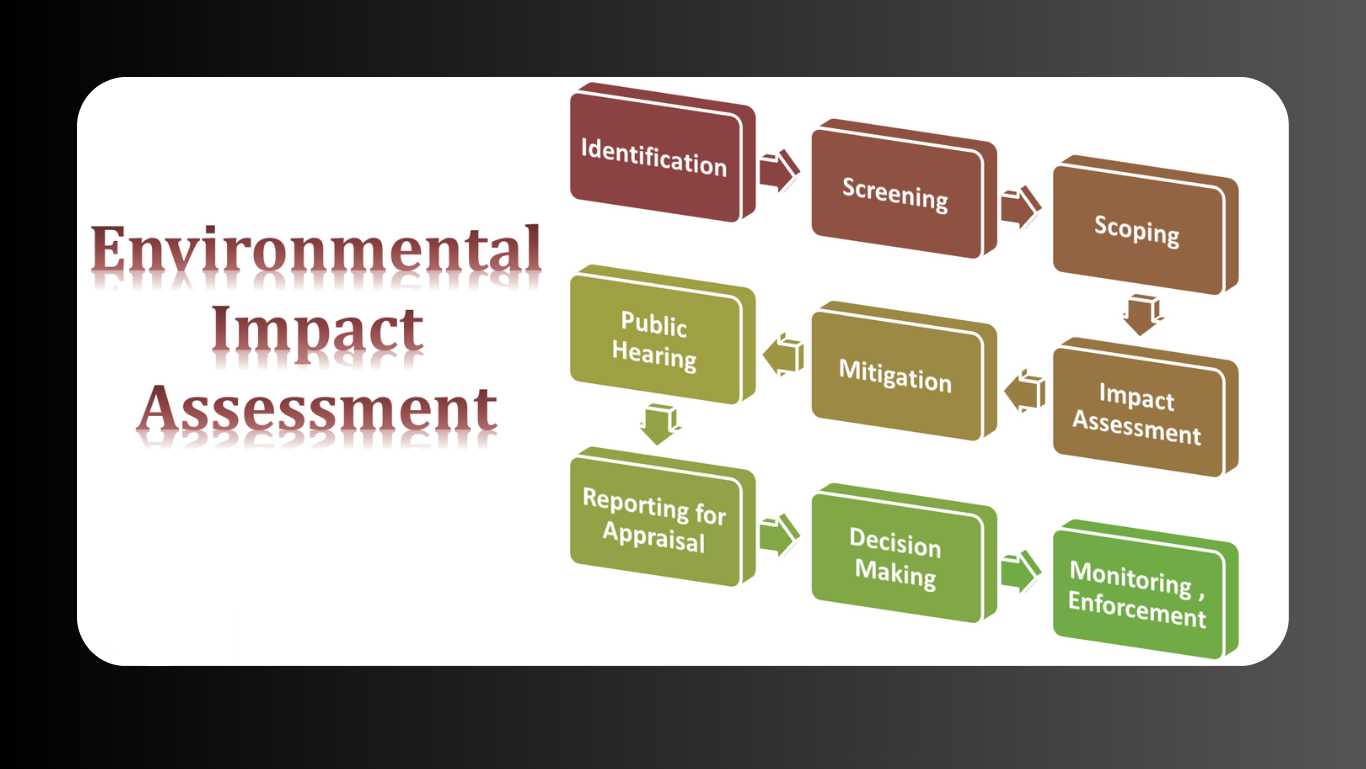
If you are planning a new factory, an expansion, or a mining or infrastructure project in India, one of the first questions you will face is whether you need Environmental Clearance — and that leads straight to the Environmental Impact Assessment (EIA). For many project teams this is the least understood part of the approval process, and also the one most likely to delay a project by months.
This guide explains what an EIA actually is, which projects need one, how the approval process works, and where most delays come from.
What is an Environmental Impact Assessment?
An Environmental Impact Assessment is a structured study that predicts what effect a proposed project will have on the environment around it — air, water, soil, noise, ecology, and the people living nearby — before the project is built. It then sets out how those effects will be avoided, reduced, or managed.
The important word is before. An EIA is not a compliance report you file once the plant is running. It is a planning tool that regulators use to decide whether a project should be permitted at all, and under what conditions.
In short: the EIA is the study. The Environmental Clearance (EC) is the permission you receive at the end of it. You cannot get the EC without going through the process.
The legal basis in India
EIA in India is governed by the EIA Notification, 2006, issued under the Environment (Protection) Act, 1986. The notification lists the categories of projects that require prior Environmental Clearance and sets out the procedure for obtaining it. It has been amended several times since 2006, so the current applicable schedule should always be checked for your specific sector.
Projects covered by the notification are placed in one of two categories:
| Category | Appraised by | Typically covers |
|---|---|---|
| Category A | Ministry of Environment, Forest and Climate Change (MoEFCC), through an Expert Appraisal Committee (EAC) | Larger projects, and projects in or near ecologically sensitive areas |
| Category B | State Environment Impact Assessment Authority (SEIAA), through a State Expert Appraisal Committee (SEAC) | Smaller projects, assessed at state level |
Category B is further split during screening into B1, which requires a full EIA study, and B2, which does not — though B2 projects still need clearance and still have to submit documentation.
The four stages of the EIA process
1. Screening
Screening decides whether your project needs a full EIA at all, and if it is a Category B project, whether it falls under B1 or B2. This depends on the project type, its capacity, and its location — a project sitting close to a protected area, a critically polluted area, or a state boundary is treated more strictly.
2. Scoping and Terms of Reference
Scoping determines what the EIA study must actually examine. The regulator issues Terms of Reference (ToR), which is effectively the syllabus for your study. Getting the ToR right matters more than most project teams expect — a vague or incomplete ToR leads to gaps that surface much later during appraisal, when fixing them is far more expensive.
Baseline environmental monitoring is normally carried out over one full season, excluding the monsoon. This is a fixed, unavoidable block of time in the schedule and should be planned for from the very beginning.
3. Public Consultation
Public consultation gives people who are locally affected by the project a formal opportunity to raise concerns. It generally has two parts: a public hearing conducted by the State Pollution Control Board in the project area, and written submissions from other interested parties. Concerns raised here must be addressed in the final EIA report.
Certain project categories are exempted from public consultation — for example, some projects located inside notified industrial estates. Whether an exemption applies to you should be confirmed at the screening stage rather than assumed.
4. Appraisal
The Expert Appraisal Committee reviews the final EIA report, the Environmental Management Plan, and the outcome of the public consultation. It may ask for additional studies or clarifications. If satisfied, it recommends grant of Environmental Clearance, usually with a set of specific conditions attached that become binding obligations for the life of the project.
What goes into an EIA report
- Project description — process, capacity, raw materials, utilities, layout
- Baseline environmental data — existing air, water, noise, soil and ecological conditions
- Impact prediction — what changes during construction and during operation
- Analysis of alternatives — site and technology options that were considered
- Environmental Management Plan (EMP) — controls, monitoring, and the budget allocated for them
- Risk assessment and disaster management plan — particularly for chemical and process industries
- Public consultation outcomes and how each concern was addressed
For chemical, petrochemical and pharmaceutical projects, the risk assessment chapter often draws directly on studies such as HAZOP and QRA. Where these studies are done properly and early, the EIA chapter becomes far stronger — and appraisal queries drop noticeably.
Where projects actually lose time
In practice, EIA delays rarely come from the regulator alone. The most common causes we see are:
- Starting baseline monitoring late. One season of data cannot be compressed. If it is started three months late, the project is three months late.
- A weak or rushed Terms of Reference. Gaps agreed at scoping resurface at appraisal, when they cost far more to fix.
- Underestimating public consultation. Local concerns that are dismissed rather than genuinely addressed tend to return as appraisal objections.
- Inconsistent project data. Capacity or layout figures that differ between the EIA report, the consent application and the project report will trigger queries.
- Treating the EMP as paperwork. Clearance conditions are drawn from the EMP and are enforceable afterwards. An unrealistic EMP creates a long-term compliance problem.
After clearance: the obligations continue
Environmental Clearance is not the end of the process. Conditions attached to the EC must be complied with, and compliance reports have to be submitted periodically for the life of the project. Alongside this, you will separately need Consent to Establish and Consent to Operate from the State Pollution Control Board, and ongoing statutory environmental compliance and reporting.
Many organisations get the clearance and then let the monitoring and reporting obligations slip. That is precisely what surfaces during an inspection or an environmental audit, and it is entirely avoidable.
Frequently Asked Questions
Is Environmental Impact Assessment mandatory for every project?
No. Only projects listed in the schedule to the EIA Notification, 2006 require prior Environmental Clearance, and the requirement depends on the project type, its capacity and its location. Some Category B projects are classified as B2 during screening and do not need a full EIA study, though they still require clearance. Whether your project is covered should be confirmed against the current notification at the screening stage.
What is the difference between EIA and Environmental Clearance?
The EIA is the study that assesses a project's likely environmental impact. Environmental Clearance is the approval granted by the regulatory authority at the end of the process. The EIA is the input; the clearance is the outcome.
How long does the EIA process take in India?
The timeline varies with project category, sector and completeness of the submission. A significant fixed component is baseline environmental monitoring, which normally covers one full season excluding the monsoon. Public consultation and appraisal add further time. Realistic planning should treat EIA as a multi-month activity beginning well before construction is scheduled to start.
Who conducts an EIA study?
EIA studies are prepared by consultancy organisations accredited by the National Accreditation Board for Education and Training (NABET) under the Quality Council of India, in the relevant sector. The accreditation must cover the specific sector of your project.
Do I still need CTE and CTO if I have Environmental Clearance?
Yes. Environmental Clearance is granted under the Environment (Protection) Act, 1986, while Consent to Establish and Consent to Operate are granted separately by the State Pollution Control Board under the Water Act, 1974 and the Air Act, 1981. These are distinct approvals and both are required.
Need expert help with this?
Our team handles Environmental Clearance and EIA studies end to end — from Terms of Reference to final approval — for projects across Maharashtra, Gujarat and pan-India.
Talk to an EIA Consultant