 +(91) 9867215033
 info@ujjwalengineers.com
 Maharashtra, Gujarat, India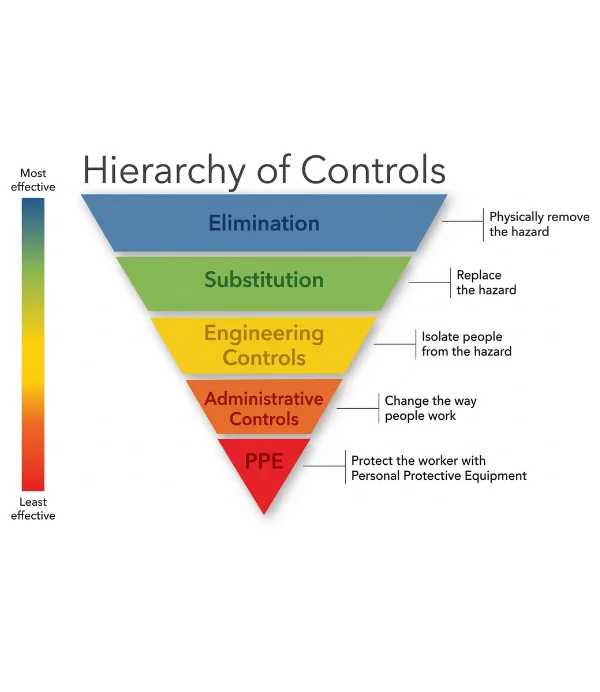
HIRA - Hazard Identification and Risk Assessment - is the study most frequently requested during safety audits, customer assessments and ISO 45001 certification in India. It is also the one most often produced once and never looked at again.
What HIRA actually assesses
HIRA works at the level of the workplace and the task. Not the process line, not the project - the specific job a specific person does, and what can hurt them while they do it.
That is what separates it from the process safety studies. A HAZOP will tell you a reactor can over-pressure. A HIRA will tell you that the operator who takes a sample from it twice a shift is standing in the wrong place while doing so.
The five steps
1. Break the work into activities
Area by area, list every activity - routine, non-routine and emergency. The non-routine ones are where most incidents actually happen: maintenance, cleaning, breakdown response, start-up and shutdown.
2. Identify hazards for each activity
Work through the categories rather than relying on memory: mechanical, electrical, chemical, thermal, pressure, height, confined space, ergonomic, noise, illumination, biological, and behavioural.
3. Rate the risk
Severity against likelihood on an agreed matrix. The matrix itself matters more than people expect - a 3x3 matrix collapses too much into the middle band, while a 5x5 gives enough resolution to prioritise. What matters most is that the definitions of each level are written down, so two assessors rating the same task arrive at roughly the same number.
4. Evaluate the existing controls
Against the hierarchy of control, in order:
- Eliminate - remove the hazard entirely
- Substitute - use something less hazardous
- Engineering - guard it, enclose it, ventilate it, interlock it
- Administrative - procedures, permits, training, signage
- PPE - last, not first
A HIRA where most controls sit in the bottom two rows is telling you something, and it is not good news.
5. Residual risk and actions
Re-rate with controls in place. Where residual risk is still above tolerance, that becomes an action with an owner and a date - not a recommendation.
Where HIRA sits among the other studies
| Study | Level | Question | When |
|---|---|---|---|
| HAZID | Project | What hazards exist at all? | Concept, FEED |
| HAZOP | Process | What can deviate? | Detailed design |
| HIRA | Workplace and task | What can hurt this person today? | Operation, ongoing |
| QRA | Facility | How likely, how severe, in numbers? | Siting, MAH |
Why most HIRA registers go stale
A HIRA is written for certification, filed, and not revisited. Then a machine is replaced, a shift pattern changes, a new chemical arrives - and the register describes a workplace that no longer exists. Auditors spot this immediately, usually by asking about the newest piece of equipment on the floor and finding it is not in the register.
What keeps a HIRA alive:
- Review triggered by change - new equipment, new chemical, new process, new shift pattern - not only by the annual calendar
- A named owner per area, not one central owner for the whole site
- Incidents and near-misses fed back into it, since they are evidence that a rating or a control was wrong
- The people who do the work involved in assessing it, because they know the workarounds that the procedure does not mention
Done properly, HIRA also feeds directly into HSE training - the register tells you exactly what your training needs to cover.
Frequently Asked Questions
Is HIRA legally required in India?
Hazard identification and risk assessment obligations arise through the Factories Act, 1948 and associated state factory rules, and through management system standards such as ISO 45001 where a facility is certified. The specific form the assessment must take varies, so the requirement applying to your unit should be confirmed against the applicable state rules.
What is the difference between HIRA and JSA?
A Job Safety Analysis breaks one specific job into steps and assesses each step, so it is narrower and more detailed. HIRA covers all activities across an area or site and rates them on a common matrix. Many organisations use HIRA for the overall register and JSA for high-risk or non-routine tasks within it.
How often should a HIRA be reviewed?
Periodically, and additionally whenever something changes - new equipment, a new chemical, a modified process, a changed shift pattern, or an incident. Change-triggered review matters more than the calendar interval, because a register that is only reviewed annually will be out of date for most of the year.
Who should carry out a HIRA?
A team rather than an individual, and it should include the people who actually perform the work alongside supervision and HSE. Assessments produced only by a safety department tend to miss the workarounds and informal practices that create real exposure.
What risk matrix should we use?
There is no single correct matrix. What matters is that severity and likelihood levels are defined in writing so that different assessors reach similar ratings, and that the tolerance thresholds reflect what your organisation will actually act on. A matrix whose top band is never used is not calibrated.
Need expert help with this?
We build activity-wise HIRA registers, calibrate the risk matrix to your operations, and train your team to keep it current.
Get Help With Your HIRA