 +(91) 9867215033
 info@ujjwalengineers.com
 Maharashtra, Gujarat, India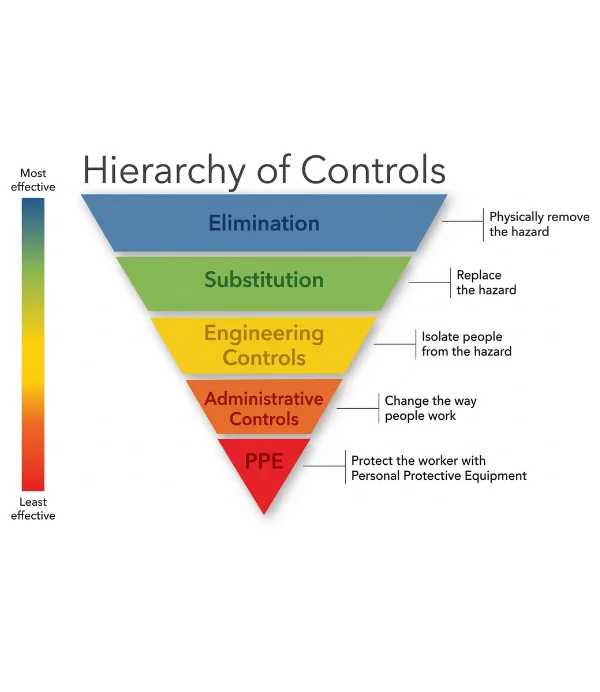
What HIRA covers
HIRA (Hazard Identification and Risk Assessment) works at the level of the workplace and the task rather than the process line. It asks what can harm the people doing a specific job, how likely that is, how severe it would be, and whether the controls in place are adequate.
It is the study most often asked for during safety audits and customer assessments in India, and it underpins the hazard identification requirements of ISO 45001 occupational health and safety management systems.
How a HIRA is built
- Activity breakdown - every routine, non-routine and emergency activity, area by area
- Hazard identification - mechanical, electrical, chemical, thermal, ergonomic, biological, and behavioural
- Risk rating - severity against likelihood on an agreed matrix
- Control evaluation - existing controls assessed against the hierarchy: eliminate, substitute, engineer, administrate, PPE
- Residual risk - what remains after controls, and whether that is acceptable
- Action plan - owners and dates, not just recommendations
Where most HIRA registers fail: they are written once, filed, and never revisited. A HIRA that does not change when a process, a machine or a shift pattern changes is documentation, not risk management - and auditors notice the difference immediately.
HIRA, HAZID and HAZOP
These get confused constantly. In short: HAZID looks at a project and asks what hazards exist. HAZOP looks at a process and asks what can deviate. HIRA looks at the workplace and asks what can hurt the person doing this task today.
A plant needs all three at different points, and they do not substitute for one another.
What we deliver
- Activity-wise HIRA register covering the full site
- Risk matrix calibrated to your operations
- Prioritised action plan with owners
- Training for your team so the register stays alive after we leave - see HSE training





 As per MOEF & CC’s (Govt. of India) Office Memorandum F.
No. 22-34/2018-IA.III dated 9th August 2018 Self-Environmental Audit shall be conducted annually. Every
three years third party environmental Audit shall be carried out.
As per MOEF & CC’s (Govt. of India) Office Memorandum F.
No. 22-34/2018-IA.III dated 9th August 2018 Self-Environmental Audit shall be conducted annually. Every
three years third party environmental Audit shall be carried out.