
 +(91) 9867215033
 info@ujjwalengineers.com
 Maharashtra, Gujarat, India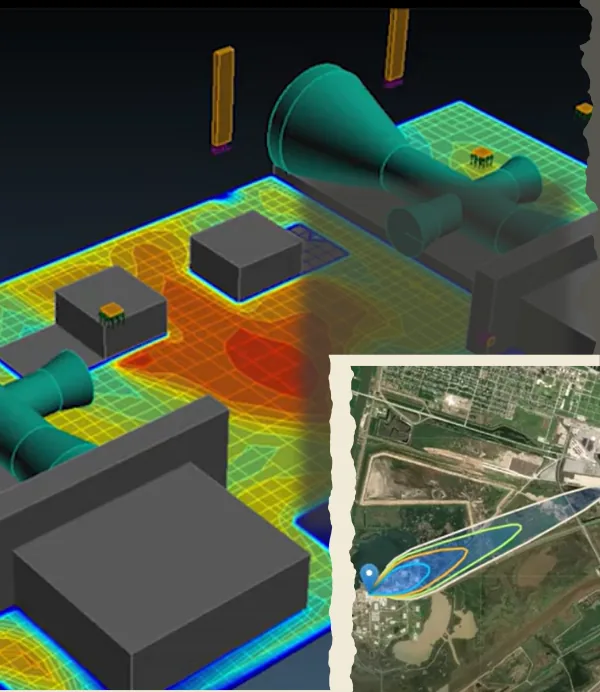
What consequence analysis answers
Hazard identification tells you a release is possible. Consequence analysis tells you what actually happens if it occurs - how far the effects reach, how severe they are at each distance, and who or what falls inside that footprint.
It is what turns "we store chlorine" into a map with distances on it.
Scenarios we model
- Pool fire - thermal radiation contours from a liquid pool
- Jet fire - radiation from a pressurised release on fire
- Flash fire - the flammable footprint of an ignited cloud
- Vapour cloud explosion - overpressure contours and their effect on structures and people
- BLEVE - fireball radiation and fragment reach
- Toxic dispersion - concentration against distance, compared to exposure thresholds
Why dispersion modelling needs real site data
A dispersion result is only as good as its inputs. Wind speed and direction distribution, atmospheric stability class, ambient temperature, humidity, surface roughness and terrain all shift the answer - often by a large factor.
We use site-specific meteorological data rather than generic defaults, because a model run on default weather produces a number that looks precise and means very little.
Where the limits are: integral models assume relatively open, flat terrain. In congested plant, around large structures or inside buildings, they can be badly wrong in either direction. That is where CFD modelling earns its cost.





 As per MOEF & CC’s (Govt. of India) Office Memorandum F.
No. 22-34/2018-IA.III dated 9th August 2018 Self-Environmental Audit shall be conducted annually. Every
three years third party environmental Audit shall be carried out.
As per MOEF & CC’s (Govt. of India) Office Memorandum F.
No. 22-34/2018-IA.III dated 9th August 2018 Self-Environmental Audit shall be conducted annually. Every
three years third party environmental Audit shall be carried out.