 +(91) 9867215033
 info@ujjwalengineers.com
 Maharashtra, Gujarat, India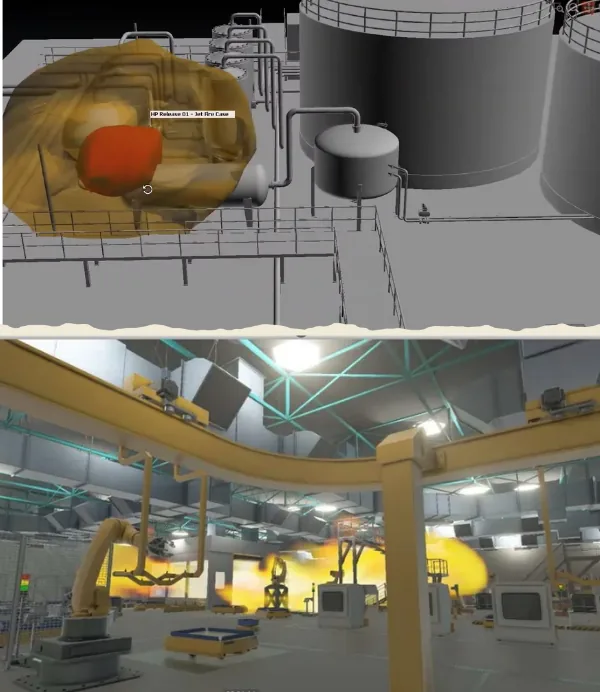
When simple models are not enough
Standard dispersion models assume relatively open, flat terrain. Real plant is neither. Structures, vessels, pipe racks and buildings change how a cloud moves, where it accumulates and how it dilutes - and in a congested area an integral model can be wrong by a wide margin in either direction.
Computational Fluid Dynamics solves the flow equations across a three-dimensional model of the actual geometry, so the answer accounts for what is physically there.
What we use CFD for
- Gas dispersion in congested areas - where a release actually goes, and where it collects
- Ventilation adequacy - whether a compressor house, analyser room or enclosure clears a leak before it reaches a flammable concentration
- Fire and smoke movement - visibility, temperature and tenability along escape routes
- Detector siting - feeding 3D fire and gas mapping with dispersion behaviour rather than assumption
- Explosion overpressure in confined and congested geometry
- HVAC intake placement for control rooms and occupied buildings
CFD is not a default. It costs more and takes longer than an integral model, and for an open tank farm it will tell you roughly what the simple model already did. It earns its place when geometry drives the answer - enclosures, congestion, or a decision expensive enough that a conservative estimate is not good enough.
What you receive
- 3D model of the relevant plant geometry
- Scenario results with concentration, temperature or pressure fields
- Visualisations that make the result explainable to people who are not modellers
- Clear statement of assumptions and limitations - a CFD report without one should not be trusted





 As per MOEF & CC’s (Govt. of India) Office Memorandum F.
No. 22-34/2018-IA.III dated 9th August 2018 Self-Environmental Audit shall be conducted annually. Every
three years third party environmental Audit shall be carried out.
As per MOEF & CC’s (Govt. of India) Office Memorandum F.
No. 22-34/2018-IA.III dated 9th August 2018 Self-Environmental Audit shall be conducted annually. Every
three years third party environmental Audit shall be carried out.