
 +(91) 9867215033
 info@ujjwalengineers.com
 Maharashtra, Gujarat, India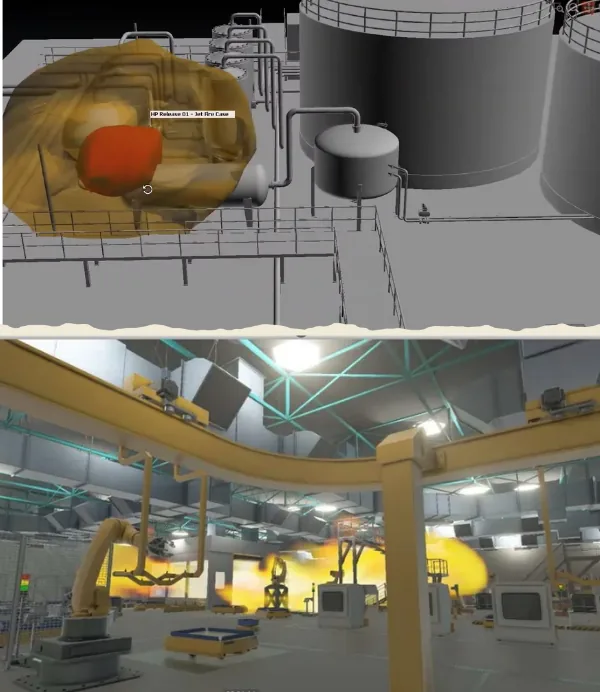
Most dispersion questions in process safety are answered perfectly well by standard integral models. CFD exists for the ones that are not - and knowing which is which saves a great deal of money in both directions.
The assumption that breaks
Integral dispersion models assume relatively open, uniform terrain. Given a release rate, weather and surface roughness, they estimate how a cloud spreads and dilutes.
Real plant violates that assumption constantly. Vessels, pipe racks, structures and buildings redirect flow, create sheltered pockets where gas accumulates, and generate turbulence that changes dilution. In a congested area the simple model can be wrong by a wide margin - and not reliably on the conservative side, which is the part that matters.
What CFD does differently
CFD builds a three-dimensional model of the actual geometry and solves the flow equations across it. The result accounts for what is physically present rather than assuming it away.
Where it earns its cost
| Question | Why CFD |
|---|---|
| Gas dispersion in congested plant | Geometry determines where the cloud goes and where it collects |
| Ventilation adequacy in enclosures | Whether a compressor house or analyser room clears a leak before it reaches a flammable concentration |
| Fire and smoke movement | Visibility, temperature and tenability along specific escape routes |
| Detector siting | Placing detection where gas actually travels, not where it is convenient |
| Explosion overpressure in congestion | Congestion drives flame acceleration, which drives overpressure |
| HVAC intake placement | Whether a control room draws in what it is meant to keep out |
When it is overkill
For an open tank farm on flat ground, CFD will spend weeks arriving at roughly what an integral model produced in an afternoon. CFD is justified when geometry drives the answer, or when the decision resting on it is expensive enough that a conservative estimate is not good enough - not as a default upgrade.
How to judge a CFD study
CFD produces persuasive-looking images regardless of whether the underlying setup was sound. Three things separate a study you can rely on:
- Geometry fidelity. Was the model built from actual plant layout, and what was simplified away? Simplification is normal; undisclosed simplification is not.
- Mesh and sensitivity. Was mesh independence checked? A result that changes when the mesh is refined is not a result.
- Stated limitations. Every CFD model makes assumptions about turbulence, boundary conditions and release characterisation. A report that does not name them is asking to be trusted rather than checked.
Where it fits with the other studies
CFD does not replace anything. It refines a specific answer that consequence and dispersion analysis could only estimate, and feeds that refined answer back into QRA, FERA and detector layout.
Frequently Asked Questions
When should CFD be used instead of standard dispersion modelling?
When geometry drives the answer - congested plant, enclosures, buildings, ventilation questions - or when the decision resting on the result is expensive enough that a conservative estimate is insufficient. For open, flat sites, standard integral models are usually adequate and far quicker.
Is CFD more accurate than integral models?
It is more capable of representing complex geometry, but accuracy still depends on how well the model was built - geometry fidelity, mesh quality, turbulence treatment and boundary conditions. A poorly set up CFD study can be less reliable than a well-applied integral model.
What is a ventilation adequacy study?
It assesses whether an enclosure such as a compressor house or analyser room clears a leak quickly enough to prevent a flammable atmosphere building up. Because the answer depends on the shape of the enclosure and the position of inlets, outlets and equipment, it is a natural CFD application.
How long does a CFD study take?
Considerably longer than an integral model. Time goes into building the geometry, meshing, running the cases and checking mesh independence. The exact duration depends on the number of scenarios and the complexity of the geometry.
Can CFD results be used for detector siting?
Yes, and it is one of the more valuable applications. Detector placement based on where gas actually travels in the real geometry is materially better than placement based on convenience or uniform spacing, particularly in congested areas.
Need expert help with this?
We run CFD studies for gas dispersion, ventilation adequacy, fire and smoke movement and detector siting in congested plant.
Discuss a CFD Study