 +(91) 9867215033
 info@ujjwalengineers.com
 Maharashtra, Gujarat, India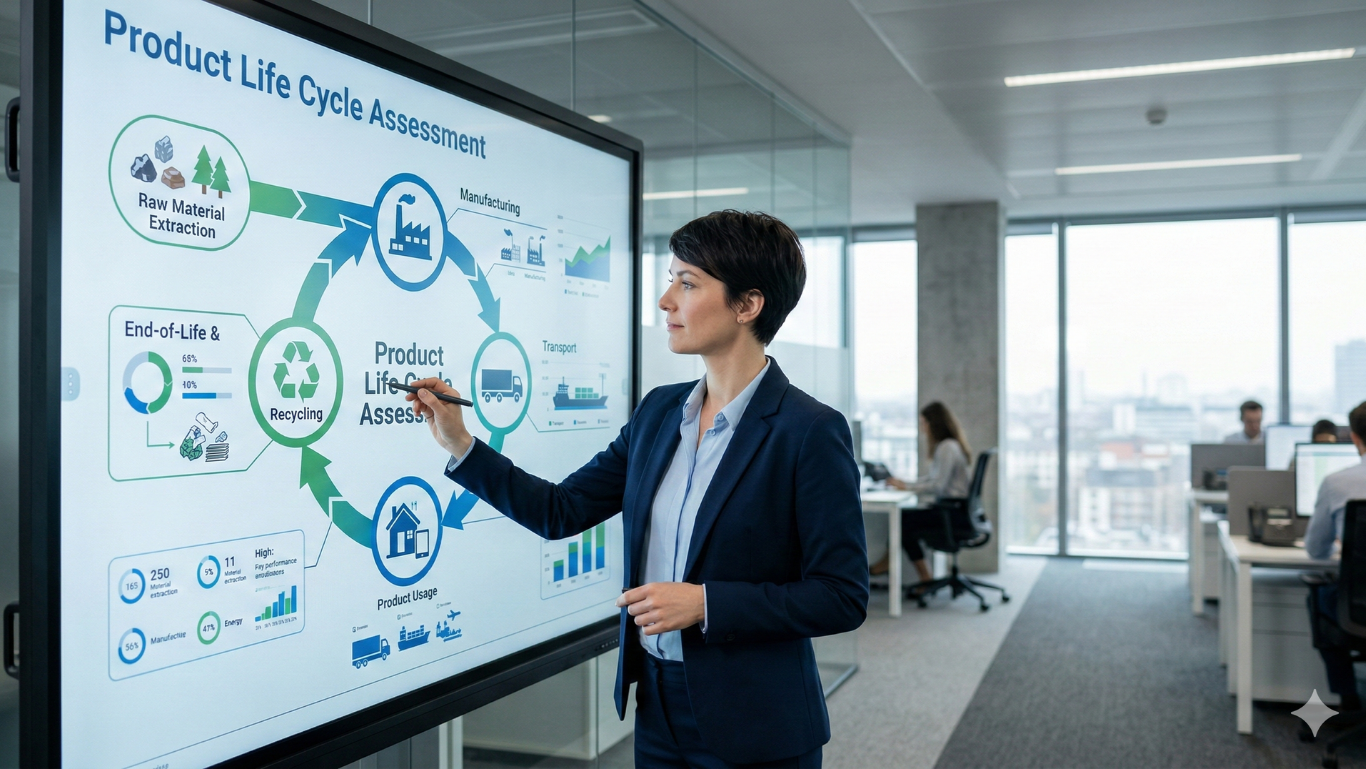
Ask most people how environmentally friendly a product is and they will think about the factory that made it. Life Cycle Assessment exists because that instinct is usually wrong. For many products, the majority of the environmental impact sits somewhere else entirely - in raw material extraction, or in how the product is used, or in what happens when it is thrown away.
What LCA measures
An LCA follows a product across its whole life and quantifies the environmental burden at each stage:
- Raw material extraction
- Processing and manufacturing
- Transport and distribution
- Use by the customer
- End of life - disposal, recycling or recovery
Crucially, it does not measure carbon alone. A full LCA covers multiple impact categories, which is what allows it to expose trade-offs: a change that lowers emissions may raise water consumption, and without LCA that shift stays invisible.
The standards
LCA is governed by two international standards. ISO 14040 sets out the principles and framework; ISO 14044 specifies the requirements and guidelines. A study that does not follow them is an estimate, not an LCA, and will not stand up when a customer's technical team reviews it.
The four phases
1. Goal and scope definition
The most consequential phase, and the one most often rushed. Two decisions shape everything:
- Functional unit - what exactly you are measuring, expressed as a unit of function rather than a unit of product. Not "one litre of paint" but "the paint required to cover one square metre for ten years". This is what makes two products genuinely comparable.
- System boundary - where the study starts and stops.
| Boundary | Covers | Typically used for |
|---|---|---|
| Cradle to gate | Raw materials up to the factory gate | B2B products, where the customer completes the chain |
| Cradle to grave | Raw materials through to end of life | Consumer products, full impact claims |
| Cradle to cradle | End of life feeds back as input | Circular economy and recycled-content claims |
2. Life Cycle Inventory (LCI)
The data collection phase, and by some distance the most laborious. Every input and output is quantified - energy, water, raw materials, emissions to air and water, waste. Primary data from your own operations is preferred; established databases fill the gaps upstream.
3. Life Cycle Impact Assessment (LCIA)
Inventory data is translated into impact categories - climate change, acidification, eutrophication, resource depletion, water use and others. This is where a long list of flows becomes something a decision maker can act on.
4. Interpretation
Results are examined for significant issues, checked for completeness and consistency, and tested for sensitivity to assumptions. Honest interpretation includes stating limitations - an LCA that reads as uniformly positive usually signals a study that was scoped to produce that answer.
Why companies commission LCAs
- Customer requirement. Large buyers increasingly ask for product-level environmental data as a condition of supply.
- Credible claims. Marketing statements about sustainability need evidence. An LCA provides it and reduces greenwashing exposure.
- Design decisions. LCA frequently overturns intuition about where impact actually sits, which redirects improvement effort to where it matters.
- Regulatory direction. Product-level environmental disclosure requirements continue to expand in export markets.
LCA and carbon footprint are not the same thing
A product carbon footprint measures greenhouse gas emissions only. An LCA measures multiple impact categories, of which climate change is one. A PCF is effectively a single-issue LCA - which is why an organisation that has completed an LCA can usually produce a PCF from the same inventory at modest additional cost.
The same inventory also supports Scope 3 reporting and strengthens the Environment theme of an EcoVadis assessment. Data collected once, used several times.
Frequently Asked Questions
What is the difference between LCA and carbon footprint?
An LCA assesses multiple environmental impact categories across a product's life cycle, including climate change, water use, acidification and resource depletion. A product carbon footprint quantifies greenhouse gas emissions only. A PCF can be thought of as one impact category drawn from a full LCA.
Which ISO standards apply to LCA?
ISO 14040 sets out the principles and framework for life cycle assessment, and ISO 14044 specifies the requirements and guidelines. A credible study should state that it follows both, and describe its functional unit, system boundary and data sources.
What is a functional unit and why does it matter?
A functional unit expresses what is being measured in terms of the function delivered rather than the quantity of product - for example the coating required to protect one square metre for ten years, rather than one litre of coating. It is what makes comparisons between different products meaningful.
How long does an LCA take?
The determining factor is data availability rather than analysis time. Life cycle inventory data collection is the longest phase, particularly where upstream supplier data is needed. Organisations with good internal consumption and production records complete studies considerably faster.
Do we need a third-party review of our LCA?
For internal decision-making it is optional. For comparative assertions disclosed publicly, ISO 14044 requires a critical review by interested parties, and customers frequently expect independent review before accepting results. If the study will be used externally, plan for review from the start.
Need expert help with this?
We carry out ISO 14040 and 14044 compliant life cycle assessments, and product carbon footprint studies built on the same inventory.
Discuss an LCA Study