 +(91) 9867215033
 info@ujjwalengineers.com
 Maharashtra, Gujarat, India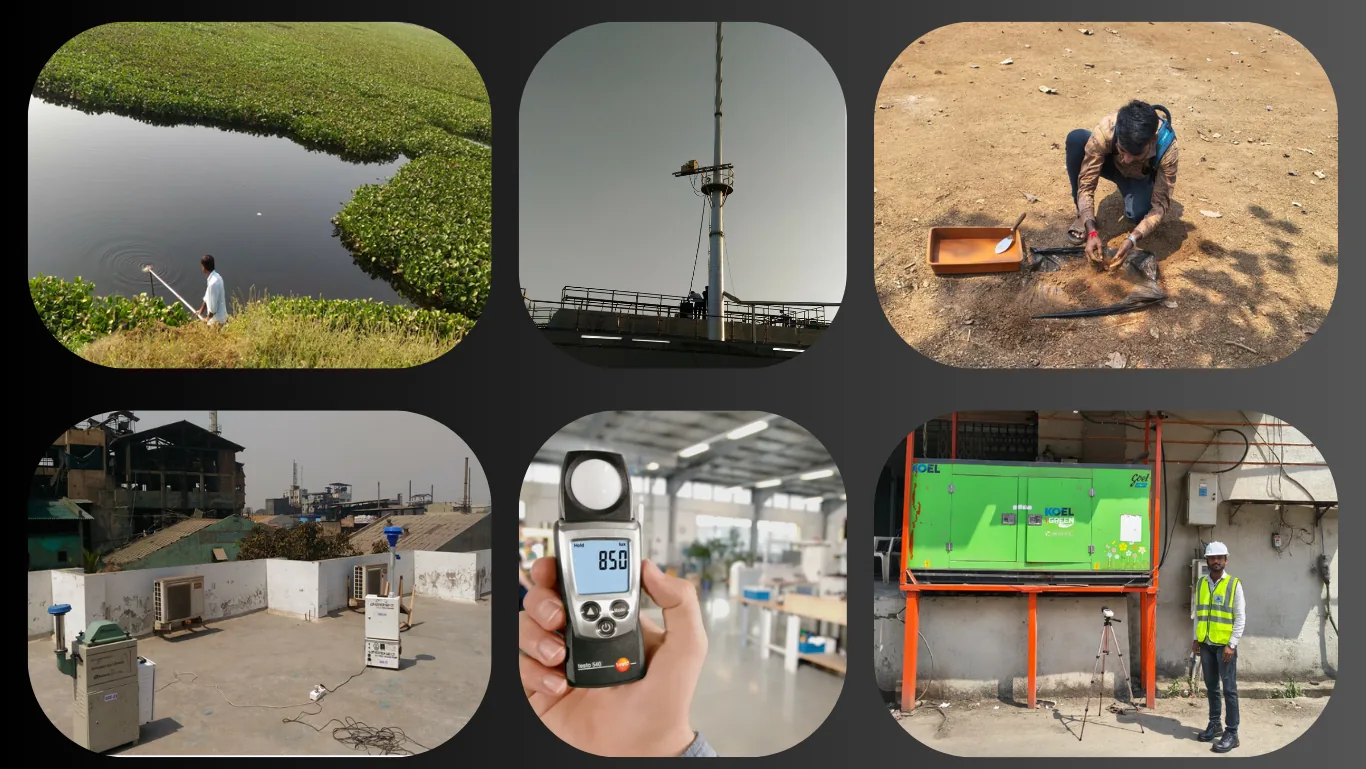
Two stack reports for the same chimney can show very different numbers, both honestly obtained. The difference is usually not the laboratory. It is the conditions the plant was running under while the sample was taken.
What stack monitoring measures
Source emission testing measures what leaves the chimney, at the point it leaves. Typical parameters:
- Particulate matter, by isokinetic sampling
- SO2, NOx, CO
- HCl, chlorine, ammonia where the process warrants it
- Volatile organic compounds, relevant for solvent handling
- Gas velocity, temperature and flow rate - needed to convert concentration into mass emission
Why isokinetic sampling matters
For particulates, the sample must be drawn at the same velocity as the gas moving through the stack. Draw too slowly and heavier particles are over-represented. Draw too fast and they are under-represented. Either way the number is wrong, and nothing in the laboratory afterwards can correct it.
The condition that decides the result
A stack result at 40% load tells you very little about full load. Monitoring should be done under representative operating conditions, and the report must state what those conditions were. A report that omits load, feed rate and operating status is difficult to defend the moment anyone questions it.
This cuts both ways. A unit that only ever monitors at low load has a file of comfortable results and no idea what its actual emissions are. When a board inspects during normal operation, the discrepancy is the finding.
Ports and platforms
Accurate sampling needs ports located with adequate straight length upstream and downstream of any bend, damper or expansion, and a platform that can be worked from safely.
Where ports are badly placed, the honest response is to say the result carries higher uncertainty - not to produce a clean-looking number from a position that cannot give one. It is worth checking port location before commissioning a monitoring programme, because relocating them later is disruptive.
What a defensible report contains
- Date, time and duration of sampling
- Plant load and operating status during the run
- Sampling method and equipment used
- Stack dimensions, port location and traverse points
- Gas velocity, temperature and flow
- Results with units and reference conditions clearly stated
- Comparison against the applicable standard
- Laboratory accreditation details
Results feed directly into your Form-V return, your consent compliance record and every inspection. Gaps in the monitoring calendar cannot be filled later, which is the single strongest argument for running it to a schedule rather than on request.
Frequently Asked Questions
How often should stack monitoring be carried out?
The frequency is normally specified in your Consent to Operate and varies with the category of unit and the parameters concerned. Because monitoring gaps cannot be filled retrospectively, the practical approach is a fixed calendar covering every required parameter and period.
What is isokinetic sampling and why does it matter?
It means drawing the sample at the same velocity as the gas flowing through the stack. If the sampling velocity differs, heavier particles are either over-represented or under-represented, and the particulate result becomes unreliable regardless of laboratory quality.
Does plant load affect stack monitoring results?
Substantially. Emissions at part load can differ significantly from full load. Monitoring should be carried out under representative operating conditions, and the report should record load and operating status so the result can be interpreted and defended.
What if our stack ports are badly located?
Port location affects measurement uncertainty, particularly where there is insufficient straight length upstream or downstream. The right response is for the report to state the limitation. Where monitoring is a recurring requirement, relocating or adding ports is usually worth doing.
Do we need a NABL-accredited laboratory for stack monitoring?
Accredited results carry more weight with regulators and are generally expected for statutory submissions. Accreditation is also parameter-specific, so it is worth confirming that the laboratory's scope covers the parameters you need tested.
Need expert help with this?
Our NABL-accredited laboratory carries out stack, ambient air, water, noise and soil monitoring in-house, on a fixed calendar.
Book Stack Monitoring