
 +(91) 9867215033
 info@ujjwalengineers.com
 Maharashtra, Gujarat, India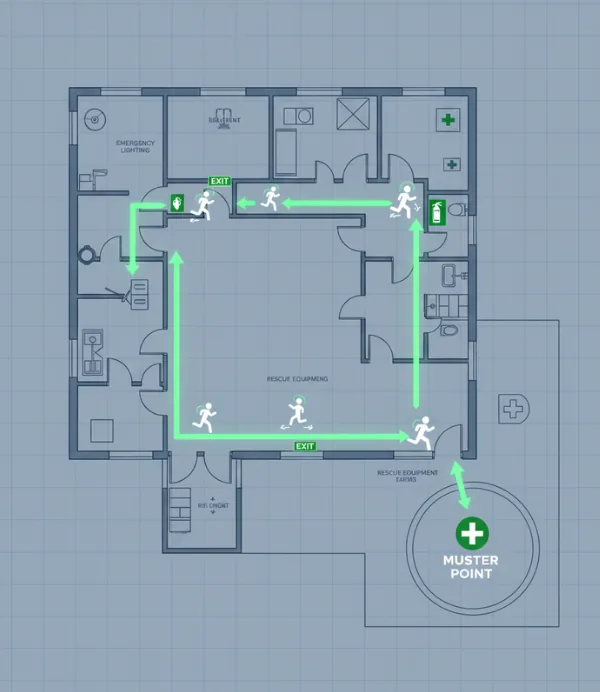
The question EERA answers
Every site has escape routes and a muster point. An escape, evacuation and rescue analysis asks a harder question: do they still work during the specific accidents this plant can actually have?
A muster point that sits downwind of the tank farm, or a stairway that passes through the radiation footprint of the flare, is worse than no plan at all - because people have been trained to go there.
How the analysis runs
- Take the major accident scenarios from the QRA and consequence analysis - jet fire, pool fire, flash fire, toxic release, explosion overpressure
- Overlay each hazard footprint on the escape routes, stairways, muster areas and evacuation means
- Check impairment - which routes and which muster areas are unusable in which scenario, and for how long
- Compare the time available for escape against the time required, including detection, alarm, reaction and travel
- Assess the temporary refuge, where one exists, for smoke and gas ingress and for endurance time
- Recommend changes - relocating a muster area, adding an alternative route, shielding a stairway, or revising the emergency procedure
Where it is required
EERA is standard practice offshore and increasingly expected onshore for major accident hazard installations, where the on-site emergency plan required under the MSIHC Rules has to be demonstrably workable rather than merely documented.
Frequently asked questions
How is EERA different from a fire drill?
A drill tests whether people follow the plan under normal conditions. EERA tests whether the plan survives the accident - whether the route is still passable when the scenario the site is actually at risk from is underway.
Do we need a QRA first?
Some form of consequence modelling, yes. EERA works from hazard footprints, so those have to exist first - from a QRA, a consequence study or a FERA.
What usually comes out of it?
Most often a muster area relocation, a second escape route from a dead-end area, or a revised procedure that accounts for wind direction at the time of the release.
Does it apply to onshore plants?
Yes. The technique originated offshore, but the logic applies anywhere the escape route can be impaired by the accident itself - which includes most chemical and petrochemical sites.





 As per MOEF & CC’s (Govt. of India) Office Memorandum F.
No. 22-34/2018-IA.III dated 9th August 2018 Self-Environmental Audit shall be conducted annually. Every
three years third party environmental Audit shall be carried out.
As per MOEF & CC’s (Govt. of India) Office Memorandum F.
No. 22-34/2018-IA.III dated 9th August 2018 Self-Environmental Audit shall be conducted annually. Every
three years third party environmental Audit shall be carried out.