 +(91) 9867215033
 info@ujjwalengineers.com
 Maharashtra, Gujarat, India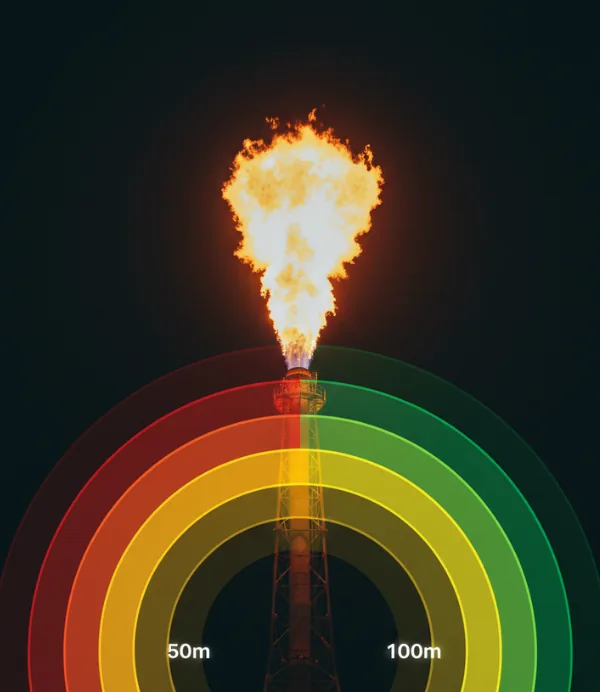
What the study answers
A flare radiation study establishes how much thermal radiation the flare puts on people, equipment and structures during relief - and therefore whether the stack is tall enough, whether the exclusion zone is big enough, and whether anyone can reach the emergency muster point while the flare is running.
The API 521 criteria
| Radiation level | Permitted condition |
|---|---|
| 1.58 kW/m² | Continuous exposure, any duration |
| 4.73 kW/m² | Areas where escape takes up to 30 seconds |
| 6.31 kW/m² | Areas where escape takes a few seconds |
| 9.46 kW/m² | Equipment only, no personnel access |
Solar radiation is added to the flare's own contribution - which is why a stack that passes in a temperate climate can fail in western India.
Scope
- Relief load determination and flare sizing for the governing scenario
- Flame length, tilt and centre position under design wind conditions
- Radiation contours plotted on the plot plan, at grade and at elevated platforms
- Sterile radius and exclusion zone definition
- Dispersion check for unignited release - a flare that fails to light is a dispersion problem, not a radiation one
- Noise and, where required, ground-level concentration of combustion products
Where it fits
Flare radiation is usually one input to a wider fire and explosion risk analysis, and the exclusion zones it produces feed directly into escape and evacuation planning. Where the flare interacts with congested plant, we run it alongside CFD modelling.
Frequently asked questions
When is a flare radiation study needed?
For any new flare, after a relief load change, when equipment or buildings are added near an existing flare, and when the plot plan changes. Adding a control room within the radiation footprint is a common trigger.
Which relief case governs?
The largest credible simultaneous relief - commonly general power failure or cooling water failure, not the single largest valve. Establishing that case is part of the study.
Can the study fix an existing flare that fails?
Options are limited but real: raise the stack, relocate the affected equipment, add shielding, or reduce the governing relief load. The study quantifies each so the cheapest workable option is visible.
Do you model unignited releases too?
Yes. A flame-out turns the flare into a source of flammable and possibly toxic gas at height, and that dispersion case is assessed alongside the radiation case.





 As per MOEF & CC’s (Govt. of India) Office Memorandum F.
No. 22-34/2018-IA.III dated 9th August 2018 Self-Environmental Audit shall be conducted annually. Every
three years third party environmental Audit shall be carried out.
As per MOEF & CC’s (Govt. of India) Office Memorandum F.
No. 22-34/2018-IA.III dated 9th August 2018 Self-Environmental Audit shall be conducted annually. Every
three years third party environmental Audit shall be carried out.