 +(91) 9284844427
 info@ujjwalengineers.com
 Maharashtra, Gujarat, India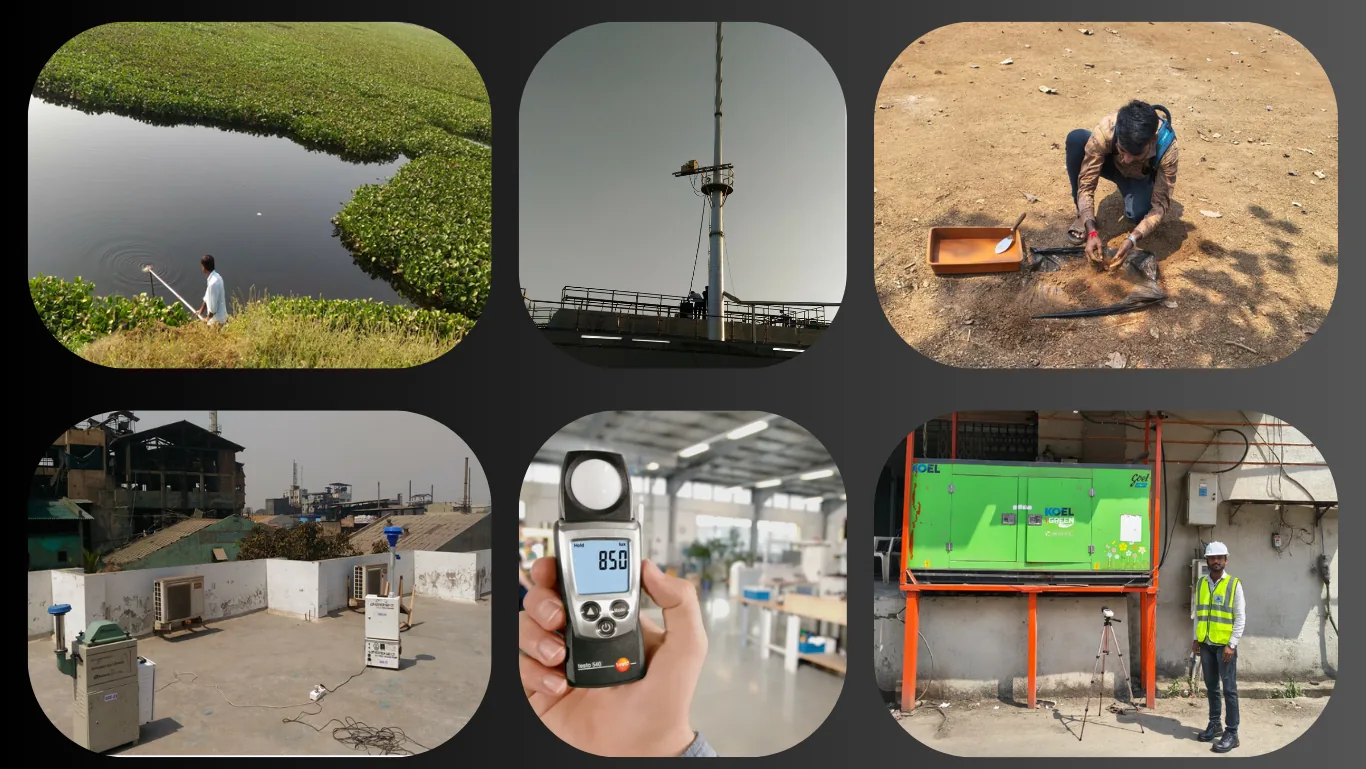
An environmental monitoring checklist turns a consent condition into a repeatable system. It identifies what must be measured, where samples must be taken, how often monitoring is required, which method applies, who will review the result and what happens when a value approaches or exceeds a limit.
The first rule is simple: do not copy another factory's environmental monitoring schedule. Requirements depend on the process, fuel, raw materials, pollution sources, site location and the conditions written into the site's Consent to Operate, Environmental Clearance and waste authorisations. A useful industrial environmental monitoring plan starts with those documents.
Compliance starting point: list every monitoring, testing and reporting condition from the applicable consent, clearance and authorisation. Where a condition and a generic checklist differ, the site-specific legal condition takes priority.
1. Build one environmental monitoring matrix
Use one controlled matrix for consent compliance monitoring rather than separate informal lists held by production, utilities and EHS. At minimum, include the following fields:
| Field | What to record | Why it matters |
|---|---|---|
| Source and location | Stack ID, ambient station, ETP point, borewell, boundary or work area | Prevents sampling at an unrepresentative point |
| Parameter and limit | Parameter, unit and applicable consent or standard limit | Allows a direct compliance decision |
| Frequency | Frequency and due date stated in the applicable condition | Prevents missed monitoring cycles |
| Method and laboratory | Sampling method, test method and approved or accredited scope | Makes results technically defensible |
| Operating context | Production rate, fuel, load, weather and control equipment status | Explains whether the result represents normal operation |
| Review and action | Reviewer, trend, action threshold, closure owner and due date | Turns data into corrective action |
2. Ambient air quality monitoring
Ambient air quality monitoring locations should represent the site and its surroundings. Record wind direction, nearby roads, material handling, unusual construction activity and other conditions that may influence the sample. Upwind and downwind logic is useful, but final locations should reflect the applicable study or approval conditions and actual site layout.
The environmental monitoring report should preserve the sampling date and time, coordinates or station identity, instrument details, weather conditions, method, result, unit, limit and laboratory record. Keep a consistent station code so trends are not broken when teams change.
3. Stack emission monitoring
Every relevant source should have a unique stack ID that matches the consent and site drawing. Before stack emission monitoring, confirm safe access, suitable sampling ports and platform arrangements. Record production load, fuel type and quantity, air-pollution-control equipment status and whether the plant was operating steadily during sampling.
Parameters and methods vary by source. Particulate sampling may require isokinetic procedures, while combustion sources may require gases and oxygen or carbon-dioxide context. The checklist should therefore point to the approved method rather than using a generic field form. See our detailed stack emission monitoring guide and stack monitoring service.
4. Effluent, wastewater and water testing
Map each water stream before sampling: raw-water source, process inlet, ETP or STP inlet, treatment stages, final outlet, reuse point and any permitted discharge point. Effluent water testing at an undefined location is difficult to interpret and may not demonstrate compliance.
Specify whether the objective needs a grab or composite sample, the container and preservation requirement, holding time, chain of custody and field measurements. Wastewater monitoring records should also capture treatment-plant operating conditions. For groundwater monitoring, use stable borewell IDs and retain location details so results remain comparable over time.
5. Noise, workplace air, soil and other site-specific monitoring
- Noise level monitoring: identify boundary and workplace points, time period, operating condition and significant nearby sources.
- Workplace air monitoring: select contaminants and locations from process hazards, worker exposure routes and the applicable occupational requirements.
- Soil testing: use it where site history, storage areas, spills, waste handling or an approval condition creates a relevant need.
- Groundwater monitoring: document borewell identity, direction of groundwater movement where known, sampling procedure and seasonal context.
Not every site needs every item at the same frequency. The matrix should be risk-based and condition-based, not a collection of unnecessary tests.
6. Check the laboratory's exact NABL scope
NABL laboratory testing is not covered by one universal approval. Accreditation applies to the specific tests, methods and ranges listed in a laboratory's current scope. Before assigning work, verify that the required matrix and parameter are covered, the certificate is current and the reporting method matches the compliance requirement.
Also check field capability: trained samplers, calibrated equipment, sample preservation, chain-of-custody controls and reporting turnaround. Accreditation does not correct a sample collected from the wrong point or under an unrepresentative operating condition.
7. Review trends and close exceptions
Do not file each report without comparing it with earlier results. Use warning levels below the legal limit where appropriate, investigate sudden changes and relate results to production, fuel, maintenance and pollution-control equipment. Record the root cause, corrective action, owner, target date and verification of closure.
An effective environmental compliance monitoring system should retain:
- the approved annual or period-wise monitoring schedule;
- sampling plans, field sheets and chain-of-custody records;
- current calibration records and laboratory scope documents;
- signed test reports and a comparison with applicable limits;
- trend charts, exception notes and corrective-action evidence; and
- proof of submission where reports must be sent to an authority.
8. Monthly, quarterly and annual control checks
Use a monthly control meeting to look ahead at due dates and operating changes. At each quarter or other applicable reporting cycle, reconcile completed tests with the consent matrix and follow up missing reports. At least annually, and whenever the process or consent changes, review the full environmental monitoring plan.
Before a pollution control board inspection, confirm that current conditions, laboratory reports, operating logs and closure records tell the same story. Our GPCB and MPCB inspection preparation guide provides a broader document-readiness checklist.
Quick environmental monitoring checklist
| Check | Complete when |
|---|---|
| Legal register reviewed | All consent, EC and authorisation conditions are mapped |
| Monitoring points verified | IDs and locations match the site and approval documents |
| Schedule approved | Every required test has an owner and due date |
| Methods and scope checked | Parameters, methods and laboratory scope are suitable |
| Operating context captured | Load, fuel, weather and control status are recorded |
| Results reviewed | Limits, trends and warning levels are evaluated |
| Exceptions closed | Corrective action has evidence and an effectiveness check |
Official references
- MPCB: consent and industrial monitoring FAQ
- CPCB: Guidelines for Continuous Emission Monitoring Systems
- NABL: laboratory search and scope of accreditation FAQ
This article is general operational guidance, not legal advice. Always apply the current central and state requirements and the conditions issued for the individual site.
Frequently Asked Questions
How often should industrial environmental monitoring be done?
Use the frequency stated in the site's Consent to Operate, Environmental Clearance, authorisations and applicable standards. There is no single universal frequency for every industry. Review the schedule whenever production, fuel, equipment, approval conditions or legal requirements change.
Which parameters should an environmental monitoring plan include?
Select parameters from the site's processes, emissions, effluent streams, hazardous materials, consent limits, clearance conditions and risk assessment. Common groups include ambient air, stack emissions, water and wastewater, noise, workplace air, soil and groundwater, but applicability is site-specific.
Is a NABL-accredited laboratory sufficient for every compliance test?
No. Check the laboratory's current scope for the exact test, matrix, method and range required. A general NABL certificate does not mean every parameter or method is covered, and field sampling controls still need to be suitable.
What is the difference between environmental monitoring and an environmental audit?
Monitoring produces measurements at defined locations and times. An environmental audit evaluates the wider management and compliance system, including approvals, records, controls and corrective actions. Monitoring reports are important evidence within an audit, but they are not the entire audit.
What monitoring records should be ready for a pollution control board inspection?
Keep the approved schedule, field sheets, chain-of-custody records, calibration evidence, laboratory scope, signed test reports, limit comparisons, trend reviews, operating logs, exception investigations, corrective-action closure and proof of required submissions.
Need expert help with this?
Ujjwal Engineers plans and carries out environmental monitoring for air, water, wastewater, noise, soil and workplace conditions through suitable testing resources and compliance-focused reporting.
Plan Your Monitoring Programme